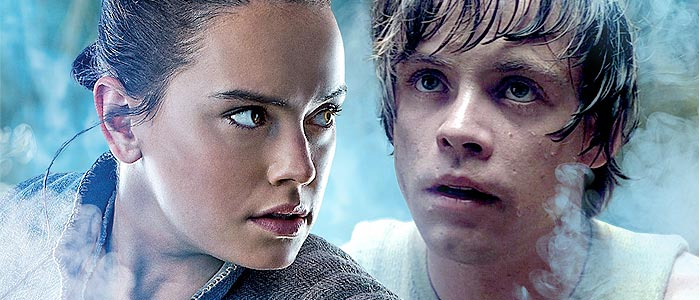
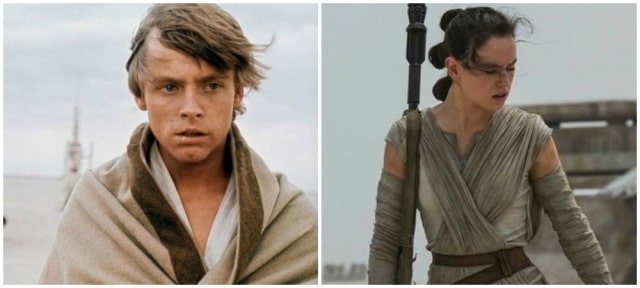
Luke and Rey are both heroes, but the reasons they are chosen for greatness could not be more different.
As we draw ever closer to the release of Star Wars: Episode IX, I’ve read numerous online articles trying to guess how Disney’s Sequel Trilogy is going to end. Not only do fans want to know how the story of Rey and Kylo Ren’s struggle will come to a close, but also how Disney will wrap up the entire Star Wars story with the movie being marketed as the “end of the Skywalker Saga.” After all, with a name like The Rise of Skywalker, their intent seems pretty obvious. With this kind of pressure from multiple directions, director J J Abrams has quite the task in front of him, not least due to the divisive reception of the previous film directed by Rian Johnson, The Last Jedi. Johnson’s film essentially split the Star Wars fandom down the middle, with fans either hailing it as a fresh and subversive entry to help grow the franchise or condemning it as a betrayal of the themes and characters that endeared Star Wars to moviegoers in the first place. Only time will tell whether this challenge to provide a satisfying ending will be met, or is even possible.
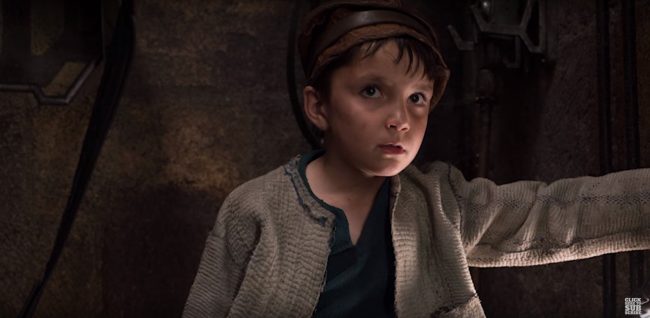
In many of these speculative articles, both authors and commenters refer back to elements of The Last Jedi and how they might be resolved, addressed, or even retconned in The Rise of Skywalker. One of the most referenced elements cites the relationship between the Force and Rey, specifically how the universe seemingly chose a “nobody” (if Kylo Ren’s revelation in The Last Jedi is to be believed) to embody the Light side of the Force and combat the Dark. They further point to the unnamed slave child character in the final scene of The Last Jedi that the internet named Broom Boy, another nobody from nowhere whose brief actions imply that the Force is still granting individuals across the galaxy with powers. Many of these articles point to the original presentation of Luke Skywalker back in 1977 as proof to support their theories. But in trying to legitimize the theme of the new trilogy by referencing what they perceive as similarities from George Lucas’ movies, these arguments completely miss the meaning of Luke Skywalker’s relationship to the Force.
You must unlearn what you have learned
In The Force Awakens, Rey is continually reluctant to commit to the adventure unfolding before her because she is afraid that her parents, who abandoned her as a young girl on the planet Jakku, will finally come to retrieve her while she is away with Han Solo and the Resistance. All Rey wants is to be part of a family, and this emphasis on her parents’ identity indicates it will be a major plot point. Throughout the story, Abrams sprinkles hints and signs that seem to suggest Rey might be related to someone we know from a previous Star Wars film. This led to almost two years of internet speculation about whether Rey was secretly the daughter of Luke Skywalker, Obi-Wan Kenobi, Han Solo and Leia, or even Emperor Palpatine. Each theory seemed more convincing (or outlandish) than the last. The idea that Rey might not be related to anyone was certainly considered, but it wasn’t until the release of The Last Jedi that this periphery theory was confirmed by director Rian Johnson.
In seeming contrast to the previous six Lucas films, Johnson argues that it’s not necessary to be part of a long lineage of Jedi or Sith in order to be strong in the Force. The Force can choose anyone for a great destiny, even if their last name isn’t Skywalker. The mystery of Rey’s past is resolved by cementing her as a “nobody from nowhere” who was chosen and gifted by the Force to embody the Light side and combat the overwhelming Dark power of Kylo Ren and his master Supreme Leader Snoke. The point is further driven home by Broom Boy, who we meet briefly in the Canto Bight casino at the end of the movie as he uses the Force to float a broom to him while he looks up at the stars, presumably dreaming of adventure with Finn and Rose, the members of the Resistance he met and helped earlier.
This idea of a “democratization of the Force” is not an objectively bad theme for a Star Wars movie for several reasons. It fits well with the ideology of Disney, a company built on the idea that “when you wish upon a star, makes no difference who you are, your dreams come true.” It also might help open up to audiences old and new the wider Star Wars universe by encouraging them to consume stories outside the films of the Skywalker Saga, a tradition started with the now-decanonized Expanded Universe body of work. This theme touches on elements present in the Prequel films, where the Jedi Order of the Old Republic routinely chose random “Force-sensitive” children and infants from all over the galaxy to train. Luke’s father Anakin Skywalker himself is presented as being immaculately conceived by the Force, as his mother Shmi tells Jedi Qui-Gon Jinn that Anakin had no father. I even think that this would have been a great theme for a separate set of films that took place in a completely different time period from George Lucas’ story. As the ending chapters of the Skywalker Saga, however, this could not be more thematically inappropriate. The original story of Luke and his trilogy is deeply based in the importance of bloodlines and lineages forming one’s destiny, a storytelling tradition itself grounded in mythological story structure. Citing Luke to support the “anyone can be important” narrative of Rey’s story misses the point of Luke’s story entirely.
I am a Jedi, like my father before me
I’d like to make an important distinction before I go forward. When I reference Luke Skywalker, I am talking about the character as he was presented in and around the original Star Wars movie and in the three films of the Original Trilogy. I know there has been plenty written since then that characterizes Luke and the Force differently, even from Lucas himself; the Original Trilogy presentation of the Force is much more mystical than that of the Prequels with its midichlorians and more science-based explanation. Most, if not all, of the arguments I have read cite the presentation of Luke in A New Hope as their proof, so that’s what I’ll focus on as well.
Much of the reason the original Star Wars has continued to be so enduring stems from the way it fits so neatly into the “Hero’s Journey” story structure, made famous by noted mythologist Joseph Campbell. (For a brief overview of Campbell and the idea of the “Monomyth,” I’d highly recommend this video from Crash Course.) Not surprisingly, Luke’s hero story borrows heavily from those of other mythic heroes from around the world and the circumstances that make them heroic. Important for our discussion is the distinction that mythic heroes often have divine or royal fathers who they are not aware of until reaching a certain age, and are usually helped by magical teachers to hone the superhuman abilities they possess as a result of their supernatural parentage. They might receive a magical weapon from their parents to help them defeat their foes, or receive a quest to rescue a princess and save a kingdom from a monstrous ruler and his evil army, rescuing the symbolic order of their parents’ rule from the chaos of the evil forces.
These story elements certainly characterize Luke, and the comparisons have been more thoroughly examined elsewhere. My purpose in identifying them here is to point out one important detail: in the overwhelming majority of these cases, the mythic hero is not a Nobody from nowhere, but a Somebody. He is a prince or a demigod– he’s special because of his supernatural or royal lineage. In an excellent lecture examining the characteristics of mythic heroes, Dr. Janice Siegel explains this is “because the mythic hero must be able to cross the boundaries that separate our world from that of the gods, to make accessible to mortals that wondrous but forbidden world,” and that the hero’s divine parentage acts as a kind of passport to this other world. This isn’t to say that there aren’t examples of people who came from nowhere or from humble beginnings but became heroes– history is full of such great people. But these figures tend to appear more in the realm of history than in mythological stories like the ones Star Wars draws from. Even then, many historical figures who rise to power tend to couch their own journey in mythological trappings, such as Julius Caesar claiming Aphrodite was his mother.

In this context, Luke’s story takes on these elements almost to the letter. We know Luke is called to his quest by both Princess Leia’s message and Obi-wan Kenobi’s urging to “learn the ways of the Force.” He receives a divine weapon from his mentor that belonged to his father and “takes his first steps into a larger world.” None of this proves he’s not a Nobody, of course: Rey gets a lightsaber from a mentor and answers her own call from Han Solo and BB-8. The key lies in the dialogue during the scene from A New Hope in Ben’s home when he tells Luke about the Jedi. Ben tells Luke he was “once a Jedi Knight the same as your father.” Ben also explains that the Jedi were the guardians of peace and justice for the Republic for a thousand generations, painting them as larger-than-life figures.
These descriptions, combined with the superhuman feats Luke sees Ben perform against the Empire’s stormtroopers, present the Jedi as semi-divine themselves. We learn later in the Prequels, of course, that the Jedi are human (or alien) and fallible like every other galactic resident. Their first appearance in 1977, however, presents them as superhuman and supernatural beings, separate from and superior to ordinary people. In mythological terms, the Jedi are the gods, and Luke’s father is one of them. Like Zeus claiming one of his children in a Greek myth or young King Arthur pulling the sword from the stone and discovering his father was a king, Luke discovers his “divine” parentage and receives his father’s godly weapon. With this weapon Luke also receives the implied quest to seek revenge on his father’s killer, a former Jedi named Darth Vader. Even years before we discover that Darth Vader, himself one of these divine figures with supernatural powers, is actually Luke’s father, we are told Luke is part of a heritage and lineage through his father. Ben essentially reveals to Luke that he has a destiny, not because he has been chosen randomly by the Force, but as a result of who his father was and consequently who Luke is in relation to his father. It is a theme embodied in the most iconic line in the entire saga: “No, I am your father.” In short, Luke is special for the same reason that Hercules, Arthur, Perseus, Rama, and every other mythic hero is: because each one is already a Somebody when they start their journey.
This is not going to go the way you think
Contrast this to what we are told about Rey. For all the complaints from various corners of the internet that Rey is unbelievably powerful in the Force with little to no instruction or training, we later learn the reason. This rationale is actually not given in the films but through the official novelization, so many moviegoers may not even be aware that any explanation exists for Rey’s sudden mastery of the Force. After Luke’s nephew and pupil Ben Solo is seduced to the Dark Side by Snoke and murders most of Luke’s other students, Luke voluntarily cuts himself off from the Force in shame and leaves the Light/Dark balance uneven in the Dark’s favor. In order to combat this, the Force itself chooses to grant Rey extreme powers of Force mastery to embody the Light side and help restore balance. Soon after the beginning of Rey’s adventure, she is captured by Kylo Ren and interrogated by him, in which he reaches into her mind and attempts to pull out what he wants by force. While they are connected, however, Rey turns the tables on Ren and “downloads” his training in and knowledge of the Force (through the apparent intervention of the Light Side of the Force itself) and is later able to escape and continue the fight against the Dark with this newly-acquired knowledge. In that moment Rey becomes the avatar of the Light Side seemingly at random, as a Nobody from nowhere.

Given the audience’s familiarity with Luke and even Anakin Skywalker in the previous six movies, it should then be no surprise that the fan theories about Rey’s parents began to fill nearly every Star Wars forum between The Force Awakens and The Last Jedi. This also can account for the confusion and anger felt by many at the explanation given near the end of The Last Jedi by Kylo Ren: that Rey’s parents were inconsequential spacers and callously left her on Jakku in exchange for drinking money. If it turns out Ren is right and Rey’s parents truly were nobodies, then the Force choosing Rey really is canonical proof that anyone can be special without having to be related to someone else.
Both The Force Awakens and The Last Jedi attempt to push back against the idea that lineage is what makes one special in several ways. The character of Kylo Ren is a prime example of this. Besides the obvious moral condemnation of making him the villain, he is presented as whiny and prone to tantrums and fits of rage. He is obsessed with living off the glory of his grandfather’s legacy without striving to make his own way; his master Snoke even reprimands him by telling him to “take that ridiculous thing off” referring to Ren’s mask modeled after Vader’s own. Trying to make one’s own way, the movie tells us, is superior to relying on the legacy of the past.
The theme is also present in the same scene as the revelation about Rey’s parents. After revealing that Rey “has no place in this story” because of her lack of important parentage, Ren offers to take Rey on as an apprentice and give her the family she has always wanted, along with the prestige of becoming part of the ancient and storied tradition of Force-users he is part of. “You’re no one,” he tells her. “But not to me.” Rey, however, rejects his offer. As if to cement this new ideology for the viewer, Ren and Rey then both attempt to claim the Skywalker lightsaber, used first by Anakin Skywalker, then by Luke, and finally passed to Rey. Kylo feels the lightsaber belongs to him, the grandson of its original wielder and therefore the heir to the destiny it represents. Rey sees the lightsaber as her connection to the Force and the family she’s always wanted, but not as the key to a special destiny. Their struggle causes the lightsaber to actually pull apart in a tremendous explosion, leaving them each with a worthless half of the mighty weapon. Symbolically, the idea of legacies determining one’s worth is over. Rey must presumably build her own lightsaber before her next confrontation instead of relying on a relic from the past, and Kylo falls deeper into failure as he is continually disappointed in his attempts to become his grandfather and take on that legacy. The lightsaber is the idea of mythic heroism made form, and now it is broken.
No one’s ever really gone

No story, whether a long series of books, a decade-spanning TV show, or a franchise of blockbuster films, can remain thematically stagnant and expect to stay relevant. The Star Wars movies are no exception, and it would seem that the powers-that-be at Disney-Lucasfilm have decided to pursue different storytelling avenues going forward than those of the traditional mythic hero. And again, there’s nothing wrong with the “Anyone can be special anywhere” message being the theme of a Star Wars movie. But trying to justify this thematic choice by saying that it’s how George Lucas always wanted the Force to be seen from the beginning of his vision is simply not true, especially when you consider how Luke and the rationale for his destiny with the Force was presented. Luke is chosen because of his family name and the destiny that accompanies it; Rey is chosen for reasons only fathomable to the Force (as far as we know). Luke’s story is closer to that of a mythic hero; Rey’s story can still be heroic, but with a very different (perhaps even polar opposite) groundwork than Luke’s.
The Sequel Trilogy’s rationale isn’t a worse reason, just a different one. But if the entire backbone of the Skywalker Saga has hinged on the idea that destiny is passed down through families and the mythological idea that being a Somebody matters, then trying to shove in a theme that completely contradicts this in the last third of the overarching Skywalker story is thematically inconsistent. If the Sequel Trilogy wants to have this as its theme, don’t brand it as “the end of the Skywalker Saga” and act confused when people say it feels like it doesn’t belong with what they know and love. To many, it doesn’t feel that Rey is succeeding in challenging the ideas about the importance of legacy and destiny by doing well in spite of the established order, but by spitting in its face and stomping on its remains. It’s not a smooth transition, despite all Disney’s praise about how successful it has been”passing on the torch” to the next generation of heroes, and the fans have felt it.
But maybe Episode IX will be an immensely satisfying ending for both its trilogy and the Saga as a whole: hearing Palpatine’s cackle in the first trailer got me excited for Star Wars again in way I haven’t been since the trailer for The Force Awakens. The title “The Rise of Skywalker” certainly implies that this will wrap up the Skywalker saga, and choosing to include the Emperor at the end of this story will almost definitely impact the information we were given in The Last Jedi, whether to confirm or contradict. Maybe this entire point I’ve tried to make will become moot. Based on what we’ve been given already, though, I doubt it. In regard to the legacy of Lucas’ story, or the importance of legacy at all, it seems Disney’s attitude is less “No one is ever really gone” but rather “Let the past die; kill it if you have to.”
And that’s a shame.
Works Cited
Erao, Matthew. “The Last Jedi Novelization Explains How Rey Learned the Jedi Mind Trick.” Screenrant. 13 March, 2018. https://screenrant.com/star-wars-rey-jedi-mind-trick. Accessed 15 May 2019.
Hutchinson, Luke. “Theory: How Star Wars 9 Can Make Rey A Skywalker (Without A Last Jedi Retcon).” Screenrant. 24 Feb, 2019. https://screenrant.com/star-wars-9-theory-rey-skywalker. Accessed 14 May 2019.
Siegel, Janice. “The Mythic Hero.” Dr. J’s Illustrated Lectures. 1997 http://people.hsc.edu/drjclassics/lectures/MythicHero/mythichero.shtm.
Crashcourse. “The Hero’s Journey and the Monomyth: Crash Course World Mythology #25.” YouTube. https://www.youtube.com/watch?v=XevCvCLdKCU.
 Culturally Opinionated
Pingback: “Let the past die, kill it if you have to”: Disney’s Star Wars and the Expanded Universe – Culturally Opinionated
Pingback: "Star Wars" and Disappointment Love Letter – Culturally Opinionated