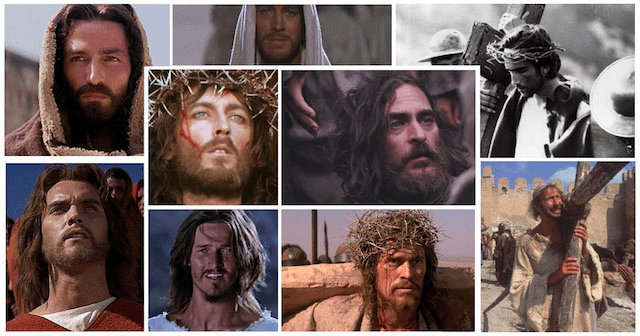
Introduction: Why do Jesus movies suck?
During my graduate program at the Vanderbilt Divinity School, my goal was to study mythology rather than contemporary religion, and I was fortunate enough to take numerous courses on all sorts of different mythological topics. But the institution is a divinity school, and I was required to take some courses that dealt with Christianity and Judaism to graduate. One of these was called “Jesus in America,” and looked at the different ways Jesus has been portrayed during the last two and a half centuries of American media. While the syllabus was full of Puritan sermons and articles debating the legitimacy of clown ministry, we also viewed a good number of movies to map the changing image of Jesus on the silver screen. When I think back to this time, my strongest recollection of these film assignments is that I felt overwhelmingly motivated to find a way to skip those particular class discussions.
Basically, I hated watching these movies.
It wasn’t that I felt some kind of animosity toward Jesus or Christianity on principle; by this time I was in my mid-20s, after all, and I like to think I had mostly grown out of a sophomoric “Jesus and church are something my parents like, so I have to actively not like them because I’m a cool teenager” attitude. But after watching the first film on the list, a silent film called The King of Kings (1927), I was just not interested in watching any more movies detailing the very familiar story about the life, ministry, and death of Jesus. I’d grown up in the Methodist church, I had two parents who have spent years teaching Sunday school, and I’d already experienced my own “awakening” into the fascinating and complex world of Biblical scholarship through Elaine Pagel’s The Origin of Satan (which I highly recommend for anyone studying the New Testament in general and the titular origin of our conception of Satan in particular). No amount of barefoot and bathrobed actors following a blonde Jesus with fantastic hair around a Hollywood sound stage was really going to add anything for me.

But in the end, I of course watched them, if for no other reason than to have input to give during the class discussions and not be seen as the type of student who didn’t prepare for class at the graduate level. For the most part, I didn’t actively dislike most of the movies, but there were only a few I can say I actually liked on any level: Martin Scorsese’s The Last Temptation of Christ has an interesting premise and execution, and seeing as I played Judas and John the Baptist in a high school version of Godspell, that movie naturally endears itself more to me.

As the end of the semester approached and I still needed a topic for a final paper, I started to wonder why I felt such hostility toward these movies. While they all shared a common theme (they all dealt exclusively with the life of Jesus as portrayed in the Gospels), as a group they could not have been more different, spanning a period of time from almost the beginnings of film to Mel Gibson’s infamous The Passion of the Christ (2004). I enjoy films from a wide variety of genres, so I felt confident there must be some connecting factor present in this group of films that caused me to not want to watch them. This led me to the conclusion that it must be the subject matter, i.e. the presence of Jesus himself. Or, more bluntly, that these movies aren’t bad because they’re poorly made; they’re bad because they’re about Jesus. After coming to this realization, I was very proud that I had solved what had seemed like such a complex problem so easily, and set out to write my final paper with a provocative premise:

The Exception: Ben-Hur
And yet, in seeming contrast to this, I was reminded of Ben-Hur.

Released in 1959 and directed by William Wyler, Ben-Hur: A Tale of the Christ has become an icon of American cinema. The story is based on an 1880 novel of the same name by Lew Wallace, and is itself actually a remake of a 1925 silent film. The 1959 version features a fantastic performance by Charlton Heston as the titular prince Judah Ben-Hur in his journey from betrayal to revenge and ultimately to forgiveness. It contains one of the most famous scenes in cinema history: the climactic chariot race between Judah and his rival Messala. It has a beautiful and rich music score, and films ever since have taken inspiration from its scenery and thematic presentation. It was also the first film to set the record for most Oscars won by a single film (11, including Best Picture, Best Actor, Best Director, and Best Musical Score), a total only ever tied by Titanic (1997) and Lord of the Rings: The Return of the King (2003). From a critical standpoint, Ben-Hur is one of the most successful movies ever made.

What drew me to compare Ben-Hur to my course assignments was the fact that it also considered a great religious film, especially around Easter. After all, the film is subtitled A Tale of the Christ. The film opens with the Biblical wise men following the Star to see the baby Jesus and only later moves on to the story of prince Judah. The last part of the film focuses on the trial and crucifixion of Jesus. Perhaps not surprisingly, Ben-Hur is shown on a 24-hour loop on certain religious TV channels every Easter, sitting comfortably as a member of the “Movies That Run on 24-Hours Loops on Holidays” club, which includes members such as A Christmas Story and It’s a Wonderful Life.
So, considering that Ben-Hur has been universally well-received and is definitely a “Jesus film,” my question became “Why is it that Ben-Hur can be so successful and still be ‘a tale of the Christ,’ and other movies covering the same story don’t even come close to achieving the same success outside their religious target demographic?” To put these other films into perspective, only four “Jesus films” have even been nominated for an Oscar (for a total of 8) between 1966 and 2004.

You’ll notice that of those 8 nominations, none of them even approach a Best Picture or Best Actor award, but are generally more technical in nature. This made me sure that there must be some important difference between these movies and Ben-Hur that would cause this disparity. And I was sure that difference was Jesus. I felt like I was getting closer to submitting my final paper.
However, after many, many hours spent reading various books and articles and watching movies, I would find that the answer was actually much more complicated than I originally thought.
 Culturally Opinionated