
Recently, Rolling Stone magazine interviewed the president of Lucasfilm, Kathleen Kennedy, in preparation for the release of Star Wars: The Rise of Skywalker in a few weeks. During the conversation, Kennedy was asked several questions about the new film’s production, such as this one:
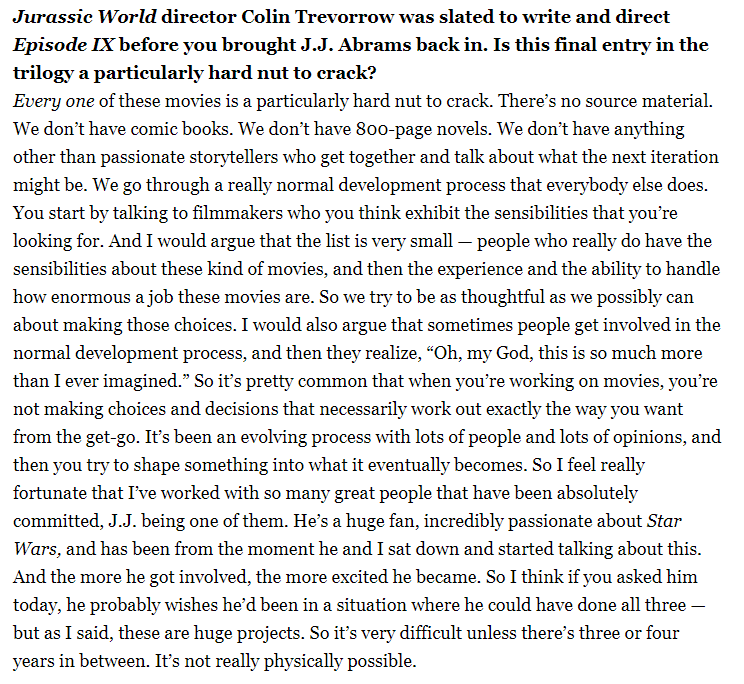
It’s these few lines at the beginning of this section, however, that have given Star Wars fans pause:

Now anyone who knows me at all knows that, while I have always been a huge Star Wars fan, I am not a fan of Disney/Lucasfilm. There are elements of the new material I actually like, such as Kylo Ren’s complex character or the new Mandalorian TV show on Disney+. As I’ve said before at length, however, overall I don’t think the new Lucasfilm has shown that they even understand core elements of why people enjoy Star Wars in the first place. Honestly, when I saw The Force Awakens at the theater and saw how the new writers had destroyed the literal star-crossed love story of Han and Leia’s story, it hurt my heart as a Star Wars fan. I’m still waiting for Disney and Lucasfilm to show me they’ve entrusted the franchise’s future to people who care about telling good stories and not just about a bottom line.
But even putting aside my personal distaste for this era of Star Wars, this statement by Kennedy is unbelievably stupid, especially coming from the president of Lucasfilm. Honestly, I am baffled that the person who is ultimately in charge of Star Wars content could be so uninformed about the property she is managing.
Let me explain.
The Star Wars Expanded Universe
Between the release of the first Star Wars film in 1977 and the acquisition of Star Wars and Lucasfilm by Disney in 2012, there were essentially two different types of material being produced under the Star Wars name. The first group consisted of the material created directly by George Lucas: the six films feature films and the 2008 Clone Wars animated series. Because Lucas had a direct hand in their creation, their status as official Star Wars canon was unquestioned.
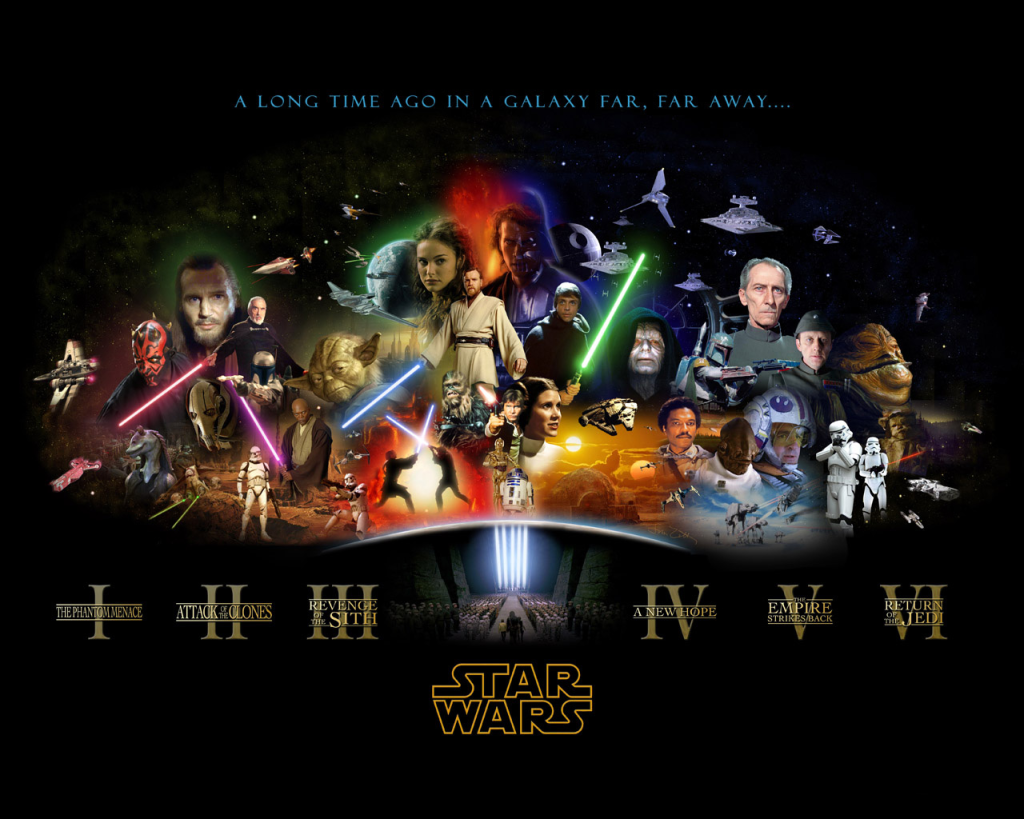
The other, much larger collection of books, video games, comics and various media by other authors and creators constituted the Star Wars Expanded Universe or EU. The canonical status of this material was more nebulous. On the one hand, everything in the EU was created by someone other than George Lucas, and therefore didn’t have the same automatic claim to authenticity as Lucas’ direct work. But on the other hand, this material was all licensed by Lucasfilm and bore the Star Wars name. In the many, many years in between the films’ releases, these works were all fans had to sustain their thirst for adventures in a galaxy far, far away.
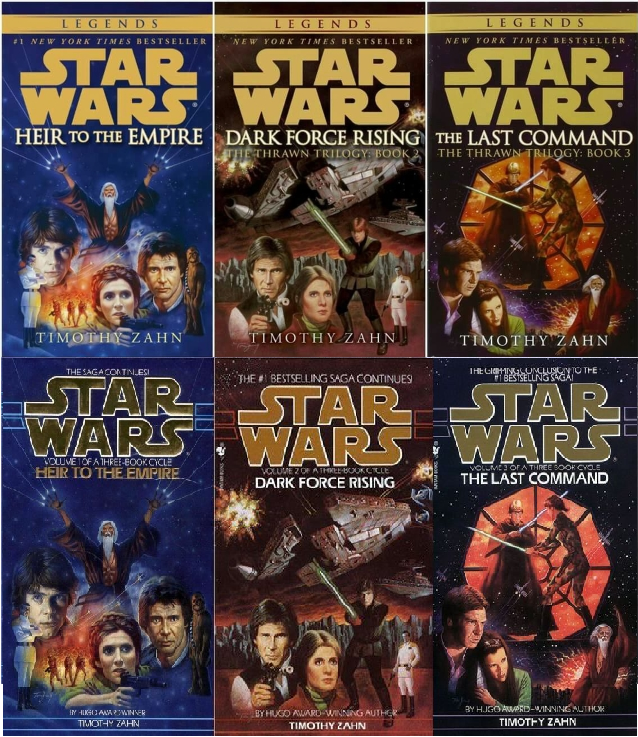
Additionally, there’s no question that the EU was extremely influential in what defined Star Wars for fans. Characters and stories from these works have become favorites among fans. Even Lucas himself took elements from EU material and “canonized” them by incorporating them into his movies. For example, Coruscant, the capital planet of the Old Republic that features heavily in the Prequel Trilogy, was actually introduced by author Timothy Zahn in fan-favorite novel Heir to the Empire in 1991. Lucas liked Zahn’s idea so much that he incorporated it into his films, thereby canonizing it in Star Wars lore.
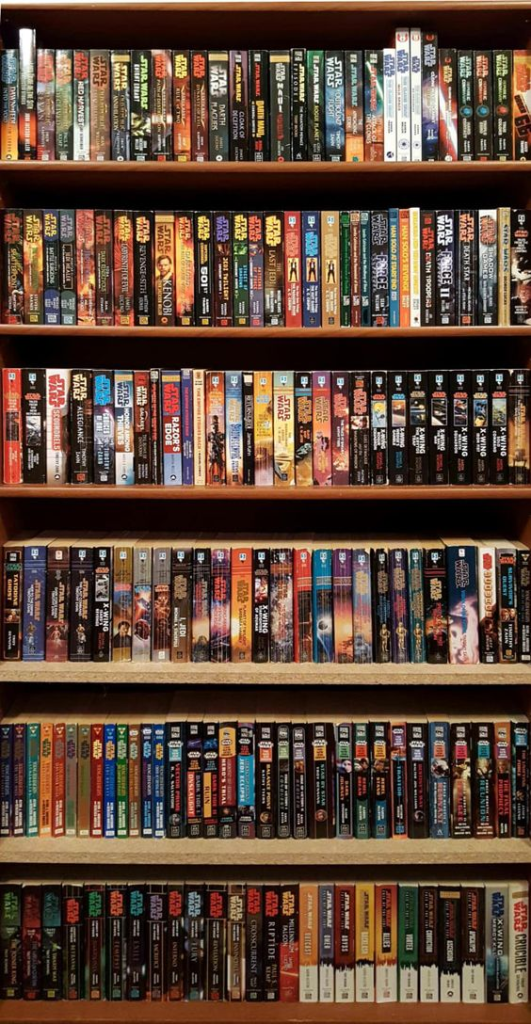
For a reference, there are nearly 400 books, 400 comics and 150 video games, not to mention the various specials and other media, produced over this 37-year period.
Then, in 2012, George Lucas sold Lucasfilm and their material to Disney for $4.05 billion. Disney now had complete creative control over all Star Wars material, including the EU. Fans were unsure of what would happen to this body of work into which they had invested so much time. Their questions were finally answered in 2014, when Lucasfilm announced that they would be “de-canonizing” all works that were not Lucas’ films, the Clone Wars show, or their upcoming show Rebels. Instead, Disney would be re-branding this material under the “Legends” banner, and all subsequent releases of these older books, comics, and other print media would have a yellow bar reading “Legends” stamped on them.
Now this makes sense from a story-telling perspective. If Disney was going to start producing their own content, they naturally would not wish to be restricted by older stories that would stop them from telling their stories their way. The new movies might wish to feature Chewbacca, for example, so Lucasfilm might want to throw out the story in which Chewie is crushed by a falling moon saving Han’s son. Personally, I didn’t like the fact that these stories I had grown up with were essentially being labeled “Star Wars, but not really” by people who had just gotten their hands on this lucrative franchise, but I understood and accepted the change.
What I was NOT okay with, however, was how the new storytellers were going to be allowed to treat these works. In official statements about the change, it was reported that “Creators of new Star Wars entertainment have full access to the rich content of the Expanded Universe.” What this said to me was that not only was new leadership going to de-legitimize what WAS Star Wars in all but name, but that they were also going to pick and choose the best elements from this immense body of work and incorporate them into their new stories without giving any credit to the original creators.
This might seem like an overreaction; after all, you might say, fans still have the books and video games where their favorite characters and stories were introduced. Fans will still know the difference between old and new material. But while the EU was very popular among a large group of Star Wars fans, the majority of audiences did not engage in the EU at all. My copy of the book Heir to the Empire first belonged to my father, but I don’t think he ever read its sequels. To my parents, and the majority of Star Wars fans worldwide, Star Wars is what they see on the screen. They don’t read any books or play any video games to fill in gaps or explore new stories. So when Disney markets their movie Rogue One (which tells the story of how the Rebels got the plans to the Death Star) as an original endeavor, this large audience of “movies-only” fans has no idea that this story had already been told in 1995. Aside from perhaps a throwaway line of dialogue or a background character as a reference that only a fan of the EU would catch and understand, there’s nothing to tell my parents that this isn’t an original idea. It does a disservice to both the fans of the original material and to the authors whose works are being picked apart without any credit being given to its rightful creators.
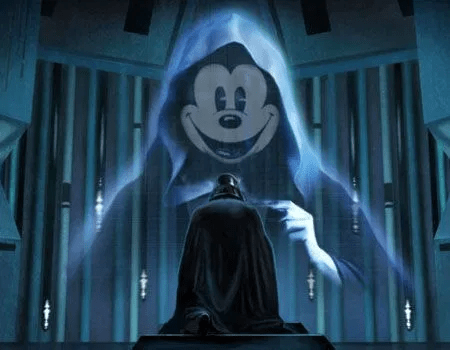
Now I certainly don’t expect Kathleen Kennedy to be the biggest Star Wars fan, even if she IS the one who is ultimately responsible for all released content. It would be nice if she were as big a fan as, say, Dave Filoni, one of Lucasfilm’s supervisory directors who is also a huge Star Wars fan. Even so, I understand that heading the entire Lucasfilm company is immensely complicated and does not necessarily require her to be passionate about the company’s content. But Kennedy is also one of the main people who helped oversee the transition of Lucasfilm’s ownership to Disney, and whose opinion presumably held a lot of sway when the decision was made to push the old EU to the side. I don’t think it’s unreasonable to expect Kennedy to have some kind of knowledge as to how influential the enormous EU body of work has been to the Star Wars brand. Statements like those in her interview certainly makes her sound like she doesn’t know what she’s talking about or that she doesn’t consider the EU important at all. As someone who grew up with the books and comics and video games of the EU for over two decades, it cements the feeling I had in 2014 when that the news of the EU’s “de-canonization” was released: that the new leadership of Lucasfilm and Disney don’t really care about their devoted fans outside of how much money they can milk from them.
I want to be clear that I don’t think that the entire Lucasfilm team feels this way. Part of the reason the aforementioned Dave Filoni is so beloved by Star Wars fans, for example, is because of how much his love for Star Wars influences how he creates quality stories for the fans. I am sure that there are plenty of other writers and creators who feel the same passion to make Star Wars better when they write new comics and novels. But based on the decisions made by the leadership of Lucasfilm and Disney, especially concerning their reactions to fan criticism of The Last Jedi, I really don’t think Kennedy or her subordinates care whether the fans like what they produce or not, so long as they pay for the privilege of experiencing it.
To help explain what I mean, let’s take a very brief look at some of the best examples of what specifically Lucasfilm under Kenndy took from these books and video games to incorporate into their new stories.
Han and Leia Having a Son Who Turns to the Dark Side
One of the biggest selling points of the new Star Wars movies has been how characters are “passing the torch” from the older generation to the next. Lucasfilm even brought back Harrison Ford, Mark Hamill, and Carrie Fisher to reprise their original roles as Luke, Han, and Leia in order to help facilitate this change. In The Force Awakens, we learn that Han and Leia’s son Ben Solo was briefly trained by Luke in the ways of the Jedi but has now turned to the Dark Side and joined the fanatical First Order to conquer the galaxy.
To fans of the old EU, this story should come as no shock. Han and Leia actually have three children in the older body of work: a set of twins, Jaina and Jacen, and a younger sibling Anakin. Jaina and Jacen technically appear as early as Timothy Zahn’s The Last Command from 1993, where Leia is pregnant with them. They are even the subject of their own series, Young Jedi Knights (1995-98), where they learn the ways of the Force at their uncle Luke’s Jedi Academy. In the New Jedi Order series (1993-2003), the children are caught up in galaxy-wide war with beings know as the Yuuzahn Vong. While their brother Anakin is killed during this conflict, Jaina and Jacen go on to become powerful Jedi and war heroes. That is, until Jacen falls to the Dark Side in his own series, Legacy of the Force (2006-08) and takes the name Darth Caedus, amassing an army which nearly conquers the galaxy under a new Sith Empire. Jacen is ultimately defeated by his twin Jaina, which may foreshadow the eventual fate of Kylo Ren during his final battle with Rey in The Rise of Skywalker. He even has an appearance as a Force ghost in the Fate of the Jedi series (2009-12).
While it can be argued that it’s only natural that Han and Leia would have Force-sensitive children who would be trained by Luke, and that one of them might fall to evil to make the story more exciting, I think it’s impossible to say Ren’s character wasn’t heavily influenced by Jacen’s body of work spanning nearly 20 years. I suppose we’ll see in a little under a month if the writers of The Rise of Skywalker decide to wrap up Ren’s story the same way as Jacen’s.
Superweapons That Aren’t the Death Star
Star Wars is full of villains with galactic’level aspirations of conquest, and what better way to inspire fear in would-be enemies that by having a powerful weapon at your disposal? As Tarkin notes in defense of the original Death Star, “Fear will keep the local systems in line.” Thanks to the popularity of the original films, the Death Star and its successor (simply called the Second Death Star) have become iconic. It’s no wonder that the new trilogy would want their own imposing superweapon. But because bigger is always better, Disney decided to up the ante on their planet-killer. Instead of a weapon that’s “not a moon,” the First Order’s Starkiller Base is an entire planet which draws its power directly from a nearby sun to destroy the five planets of the Hosnian system (and the headquarters of the New Republic) at once.
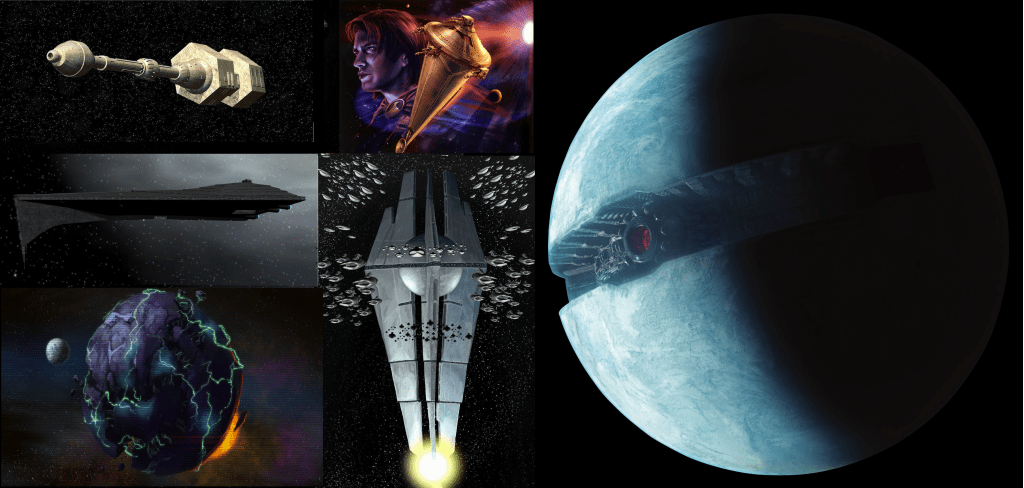
But even apart from the Death Star, there have been many different superweapons introduced throughout the EU’s history. Referencing the picture above, from top left counterclockwise, we have:
- the Galaxy Gun, a weapon commissioned by the reborn Palpatine (more on that later) which fired projectiles warheads that could destroy an entire planet;
- the Sun Crusher, another Imperial weapon that used torpedoes to cause stars to go supernova;
- the Star Forge, a massive weapons manufacturing facility that used the Force and the power of stars to create endless amounts of ships, droids, and weapons (it also fed off the negative feelings of its creators and became a Dark Side weapon);
- the Mass Shadow Generator, a weapon that destroyed two entire fleets of ships and a nearby planet by manipulating gravity; and
- the Eclipse, the first Eclipse-class Super Star Destroyer that featured a laser which could pierce planetary defenses and devastate worlds.
There are many more weapons of mass destruction, both large and small, that threaten the galactic stability of the old EU. With such a varied and extensive catalog to choose from, it’s a little surprising that Lucasfilm decided to simply go with “even bigger Death Star!” Nevertheless, the contributions of so many authors and their doomsday devices was surely a large factor in the planning of Starkiller Base.
Palpatine Reborn
With The Rise of Skywalker just over the horizon, we’ll soon (hopefully) find out the specifics of the Emperor’s return after his supposed death at the end of Return of the Jedi. After all, one of the main goals of the Rebellion was to defeat the Emperor’s evil, and Vader’s redemption was accomplished by him ridding the galaxy of Palpatine himself. If Palpatine is still alive, it might seem to cheapen the impact of the original story’s ending.
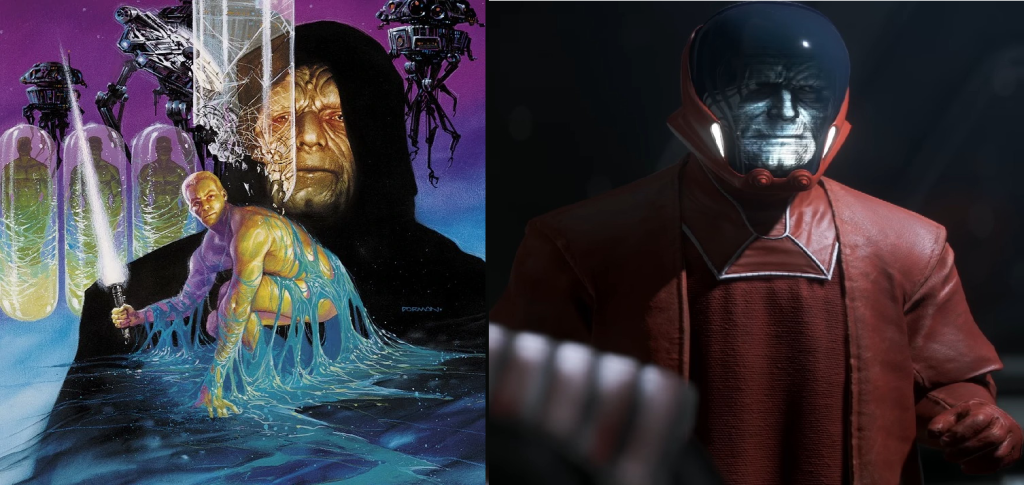
Regardless, the idea that Palpatine would be so powerful in the Dark Side of the Force that he would find a way to cheat death isn’t a new one. In the old EU, Palpatine transfers his life energy in clone bodies in order to be reborn again and again, and it is only by destroying these clones that he is finally defeated. We’ll have to see how Palpatine was able to return this time and what consequences, if any, this will have for the galaxy in the new continuity.
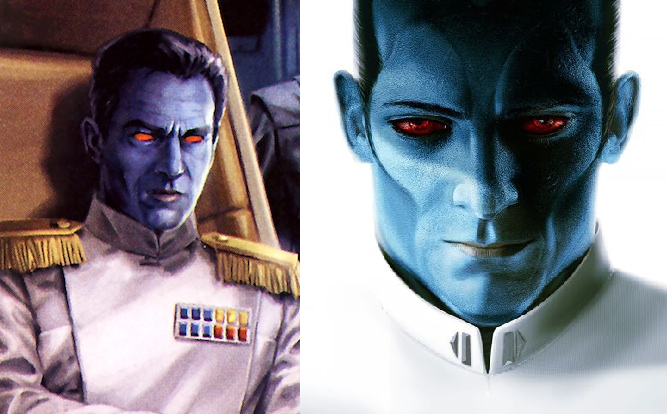
Grand Admiral Thrawn
Of all the entries on this list, Grand Admiral Mitth’raw’nuruodo (Thrawn) represents perhaps the most blatant example of Disney/Lucasfilm taking “inspiration” from older authors and ideas. The “Thrawn Trilogy” of novels by Timothy Zahn is arguably the most popular and well-liked piece of Star Wars media that wasn’t directly created by George Lucas. Set five years after Return of the Jedi, the trilogy focuses on the conflict between the New Republic (led by Luke, Han and Leia) and the remnants of Palpatine’s Empire led by Thrawn, the Emperor’s greatest surviving general. One of the reasons fans are so enamored with the trilogy deals with how Zahn flips the traditional Star Wars narrative on its head; instead of a resource-strained Rebellion fighting a seemingly-unwinnable battle against a resource-rich Empire, Thrawn and the Imperial forces must use cunning and strategy to overcome the much larger New Republic forces. Thrawn was ultimately unsuccessful in conquering the New Republic, but his status as a worthy adversary for our favorite heroes was cemented in Zahn’s 1991 novel and has remained strong since.
Thrawn has been so popular, in fact, that when Disney/Lucasfilm were developing the third season of their Star Wars TV show Rebels they decided to reintroduce Thrawn as the main antagonist. Many longtime fans were initially excited to see the great military strategist back in action, especially in a television format. As Rebels has now finished its fourth season, however, complaints about Lucasfilm’s new misuse of Thrawn have become more frequent in some fan circles. Instead of the genius general who overcame overwhelming odds, Thrawn becomes more of a bumbling villain whose schemes mostly fail because of the heroes’ luckiness. It sometimes comes off less like a serious struggle in a space opera and more like a Scooby-Doo villain having trouble with Those Meddling Kids. Whatever your opinion of the new Thrawn, the reason he has been reintroduced in the first place is a direct result of his popularity from the old EU.
It’s worth briefly noting that, while many new Star Wars concepts that are “borrowed” from the old EU are handled by the current Lucasfilm story group, the current leadership actually brought Timothy Zahn back to write material for the new version of Thrawn. Zahn has since been consulted on the TV show as well as written a new Thrawn trilogy (2017-19). As a fan who was very turned off by the de-legitimizing of the old EU material, allowing Thrawn’s creator to have a say in the new direction the character is taking goes a long way toward endearing me to the new Star Wars canon.
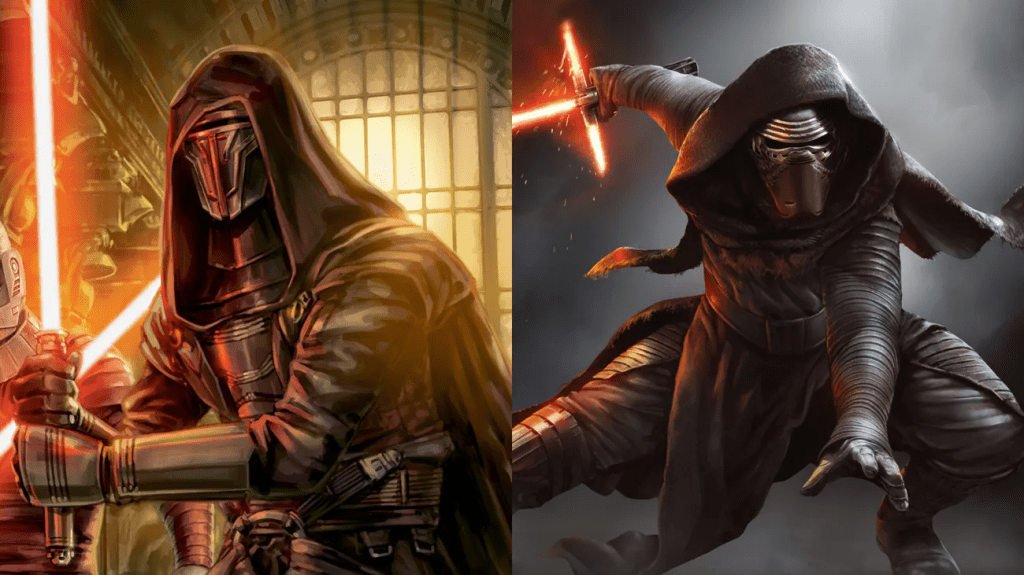
The Design of Kylo Ren’s Helmet
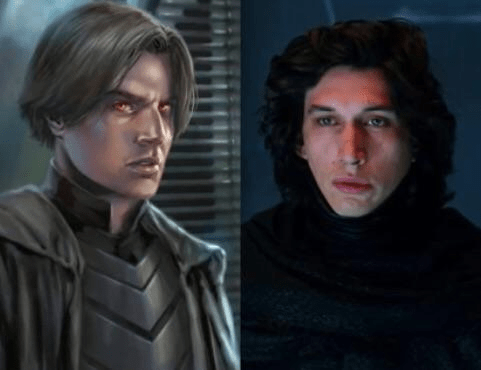
This is a small similarity, but one that has bothered me since I first saw the promotional art for The Force Awakens. On the right is Kylo Ren, the new trilogy’s villain. According to the movie, Ren’s helmet that is designed after that of Ren’s grandfather, Darth Vader, who Ren wants to emulate as closely as possible. I’m willing to accept this as the rationale for the helmet’s design in the context of the story.
But take a look at the picture on the left. This is Darth Revan, a Sith Lord from the old EU who first appeared in the critically-acclaimed and much-loved video game “Knights of the Old Republic.” Revan’s story takes place approximately 4000 years before the original Star Wars movie, and he has remained a fan favorite since the game’s release in 2003. Revan’s and Ren’s helmets are of course not exactly the same, but Ren’s helmet design is obviously inspired by Revan’s. Naturally, casual fans who have only seen the Star Wars movies would not have any of idea this influence, but I find it hard to believe that the Force Awakens design team were unaware of this very popular character who has been in Star Wars lore for a relatively long time.
On a side note, I have read fan theories that speculated the new canon writers may have designed Ren’s helmet to be so similar to Revan’s on purpose. Lucasfilm has realized that there are certain characters that longtime fans will not easily let go of, and that could therefore be profitable to them if they were to re-introduce them into the Star Wars canon. Reven is certainly one of these characters, and slowly there have been subtle hints that Lucasfilm may be bringing him back sometime in the future. If Ren was inspired not only by the decisions of his grandfather but also an ancient Sith Lord with a cool-looking helmet, it would go a long way to explaining this obvious similarity (in the context of the Star Wars universe, at least). If you’re interested, you can read that theory laid out here.
A New Hope
There are many, MANY more examples of material from the old EU that have been re-introduced, either explicitly or in a slightly changed form, into Star Wars canon. With new projects like Episode IX or The Mandalorian show on Disney’s streaming service, the list continues to grow. Whether you believe this is an opportunity for fan-favorite elements to finally receive the same legitimate status as Lucas’ original work, or that the storytellers at Lucasfilm are out of original ideas and have decided to cannibalize material that was previously unappreciated, there is no question that the influence of nearly 35 years of material is still strong among fans.
And again, I would not really expect Kathleen Kennedy to be hugely passionate about Star Wars in the same way fans and story directors like Dave Filoni are. She’s running a business, not writing stories, so she has her own problems to worry about. But saying that Lucasfilm “[didn’t] have anything” is just inexcusable given Kennedy’s position as the head of Lucasfilm. Perhaps she would do well to look at the income Disney still receives from the sale of these old works under the Legends banner, or the immensely positive fan reaction to the announcement of Thrawn’s return or rumors about the possibility of a Knights of the Old Republic film. The legacy of the old EU lives on. To quote Luke from The Rise of Skywalker trailer: “No one’s ever really gone.”
 Culturally Opinionated
Pingback: "Star Wars" and Disappointment Love Letter – Culturally Opinionated