

Now that we’re practicing social distancing measures as a nation and my job is finally letting me work from home, we can jump back into our look at pre-Iron Man superhero filmography with some of the most well-known and well-loved superhero movies of all time: the Sam Raimi Spider-Man trilogy.
The Spider-Man trilogy was an extremely influential group of films, not only for the superhero genre but for modern film in general. (It can certainly be argued that the first X-Men movie, which was released in 2000, was more influential simply because it came 2 years before Spider-Man. I’m honestly not sure that’s the case, as I’ll explain later.) It’s the reason we have the Marvel Cinematic Universe, which has become such a huge factor in shaping the current landscape of film-making. Its popularity was the reason Christopher Nolan was so successfully able to bring Batman back to the movies after the disastrous Batman films of the early 1990s, giving competition to the Marvel juggernaut. Even though some movies had successfully blended comic book elements with a real-world setting (such as Blade), Spider-Man accomplished this so well that it influenced nearly every superhero movie after it (how many superhero movies have been made recently that DON’T take place at least somewhat in our contemporary world?). And of course, there’s hardly a person alive today who can’t quote the film’s underlying theme: “With great power comes great responsibility.”
We’re all familiar the story: mild-mannered Peter Parker is bitten by a radioactive spider and is given the ability to crawl on walls, shoot webs (from his hands, thankfully), and a “spider-sense” that warns him of danger. Everyone knows this story, and while the comics and even Saturday morning cartoons were very popular with their audiences, Spidey’s immense general popularity is largely thanks to these films. When Spider-Man was released in 2002, it was the highest-grossing superhero movie at that time. It was also extremely popular with general audiences and comic book fans alike for its take on the friendly neighborhood web-slinger, ensuring a large audience eager to spend their dollars on tickets for years to come. The 2004 sequel, Spider-Man 2, is widely upheld by critics and fans as one of the best superhero films in history. And despite some unpopular story decisions and cringey moments, 2007’s Spider-Man 3 does a good job of wrapping up this trilogy.
These movies also hold a special place for me in that they were the first superhero films I can actively remember seeing in theaters. As much as we are culturally moving away from traditional theaters and more toward streaming, there really is nothing that beats going to see a good action film on a big screen in a dark theater in surround sound. Coupled with the excellent story and (for the time) impressive special effects, middle-school George and the rest of America were blown away.

In more recent years, the Spider-Man trilogy has managed to stay popular in the public consciousness through the use of its scenes in Internet memes. The current state of online “meme culture,” the currency of nostalgia, and the versatility of memes in general have allowed younger people who may not have seen these movies to nevertheless understand and reference them almost in their entirety. So what better way to express my thoughts on the film than through stupid Internet memes?
Before we dive in to the movies themselves, we need to take a moment to talk about what is perhaps the biggest strength of this version of Spider-Man’s story: the casting choices of its main characters.
To open with a controversial opinion: Tobey Maguire is the best Peter Parker to date in film. This isn’t to say that other cinematic Spider-Mans (Men?) haven’t been good in their own way. Andrew Garfield’s portrayal in The Amazing Spider-Man (2012) nails the quippy-ness of Spider-Man from the comics and features good chemistry with his love interest (Emma Stone’s Gwen Stacy), but is frequently criticized for being “too cool” for fans of nerdy and awkward comic Peter Parker. And while Tom Holland’s magnetism makes him currently very popular with movie-going audiences, especially younger viewers, the idea of Spider-Man as a globe-trotting, world-saving Avenger might work against the “friendly neighborhood Spider-Man” image audiences are more used to.

Which actor’s portrayal speaks most to you is, of course, a personal opinion (including mine). And it DOES sometimes help to be first, as is the case here. But I don’t think the importance of Maguire’s role for the Spider-Man franchise specifically and for the superhero genre in general is a matter of opinion. To quote this article from CinemaBlend.com:
Maguire’s work can also be underestimated when it comes to introducing this pivotal comic book character to the masses. It is often through Maguire’s likable performance the general public had a better understanding of the character and his mythos. And it is through that understanding of the character that I would assume they grew to appreciate and respect the following movies.
https://www.cinemablend.com/news/2476957/tom-holland-vs-andrew-garfield-vs-tobey-maguire-who-is-the-better-spider-man
Within the story itself, Maguire’s Peter Parker is especially endearing to the audience because of his reliability. Peter drips sincerity, and comes off as a hugely appealing throwback to the black-and-white morality of many comic books from the 50s and 60s (from which Spider-Man was born) as a result. You at times almost expect him to throw in a “Gee whiz!” during a fight. The script isn’t afraid to be earnest, even corny, and that earnestness goes a long way toward making us like Peter. It’s one thing for a character to be sympathized with or simply understood by the audience; I would argue we sympathize with Chris Evans’ Captain America or are charmed by Robert Downey Jr.’s Iron Man more than we “like” them. Maguire’s Spider-Man, though earnest and corny, is truly likable, and that can go a long way establishing a character in the public consciousness.
Another spot-on casting decision goes to Peter Parker’s guardians, Aunt May and Uncle Ben, played by Rosemary Harris and Cliff Robertson, respectively. Although Uncle Ben is only really present in the first film (he appears in a flashback during the second movie) and then only briefly, Robertson does a fantastic job of making us care about his character. There is no doubt that he also has the most iconic moment of any other character in the trilogy with his famous line “With great power comes great responsibility.” And while the main focus of his death scene is shifted to Peter in that Peter is unintentionally responsible for the tragedy, Robertson’s performance really drives the moment home.

Similarly, Rosemary Harris’ Aunt May is extremely endearing as a parental figure in general, not just as Peter’s guardian. She cares about Peter in a very genuine way throughout all three films. So when Aunt May is being terrorized by the Green Goblin or dangling in Dr. Octopus’ arms several stories over the New York streets, we feel genuine concern for her safety, maybe even more so than for Mary Jane in some cases. And she is NOT a passive character, either. During Spider-Man 2, she helps Spider-Man in his fight against Dr. Octopus as he attempts to underhandedly kill the web-slinger, remarking “Shame on you!” before striking him with her umbrella. Harris also brings a wide range of emotion to the role. She playfully teases Peter about his feelings for Mary Jane in the first movie, then deliberately withdraws her hand from Peter’s after he confesses his role in Ben’s death in the second film, then sagely gives Peter (and Spider-Man) the moral boost he needs with an Uncle Ben-esque speech “I believe there’s a hero in all of us, that keeps us honest, gives us strength, makes us noble, and finally allows us to die with pride. Even though sometimes we have to be steady and give up the thing we want most, even our dreams.” The range of Harris’ acting make Aunt May stand out in a way no other version’s has since.
James Franco is also a compelling Harry Osborn, Peter’s rich best friend. The evolution of Harry’s character is great throughout the trilogy as he wrestles with his inner demons: jealousy that his both father Norman and Mary Jane favor Peter over Harry; hatred of Spider-Man for (Harry believes) Spider-Man’s murder of his father, and then agony after he discovers Peter and Spider-Man are the same person; and madness as he attempts to live up to his father’s legacy as the Green Goblin, a persona that feeds on his fears and drags him into his own personal hell. Franco maintains a great balance between Peter’s steadfast friend, a son desperately craving his father’s approval even after his father’s death, and in the final movie a Machiavellian villain slowly destroying his adversary’s world. He also gets a redemption at the end of the trilogy, making his death at the end of Spider-Man 3 a sad yet satisfying ending for his character.
Kirsten Dunst as Mary Jane Watson is probably the weakest of the trilogy’s main characters, but I don’t think that stems from a failing on the actress’ part. Mary Jane has historically acted primarily as romantic interest for Peter Parker, and although she’s gotten some stories of her own over the years, she hasn’t really deviated from being a love interest/ damsel in distress. Dunst herself is very likable in these movies, and I think she and Maguire have good on-screen chemistry. In trying to present a more authentic version of Mary Jane, Sam Raimi gives Dunst a likable but sort of boring character. So I feel like the hate she gets is undeserved, and Dunst does the best with what she’s given.

Lastly, I can’t talk about the casting for these movies without mentioning J.K. Simmons’ performance as J. Jonah Jameson, editor-in-chief of The Daily Bugle. In the history of film, there have been a few actors who were born to play certain characters. This is one of those instances. From Wikipedia:
Portrayed as a blustering, bombastic, obsessed, hyperactive man, the film version of Jameson retains his dislike for Spider-Man, and takes delight in anything that might discredit or defame him, but remains a good man at his core, putting his life on the line to protect Peter from the Green Goblin.
https://en.wikipedia.org/wiki/J._Jonah_Jameson#Films
Here we have another instance where being first has a large impact on what comes after, where Simmons’ performance is so spot-on to his comic and TV cartoon portrayal that the actor has become inseparable from the character. Simmons even reprises his role and makes a cameo at the end of the recent Marvel film Spider-Man: Far From Home. There’s something to be said about being asked to reprise your role in a franchise that recasts its characters every few years.
Now, on to the films themselves. Much and more has been said about these great movies, so these thoughts will be brief. Naturally, beware of spoilers. But honestly, these may be the first films we’ve analyzed where that won’t matter because of their popularity.
Spider-Man (2002)
Of the many, many superhero origin stories that have been adapted to film over the last couple decades, this version of Spider-Man’s origin is one of the best. It’s certainly one of the most influential; when Marvel brought their own Spider-Man into the MCU, they didn’t even really DO an origin story because of the popularity of this movie and its story. It really represents a standard to be held against in the superhero genre.
This is especially true considering the contrast between Peter’s story and the story of this movie’s villain, Norman Osborne/Green Goblin. Whereas Peter has greatness thrust upon him by the chance spider bite and rises to the challenge, Osborne hurriedly overreaches for power out of fear that the government funding for his project will be revoked and is consumed by his creation. Both Peter’s and Osborne’s superpowers amplify what was already inside them, which really hammers home the theme about responsibility when presented with power.
To his credit, Osborne does try to fight the Goblin persona that eventually overtakes him, and it’s genuinely sad when, at the climax of Spider-Man’s fight with the Goblin, Norman regains control of himself on his deathbed just long enough to reach out to Peter and beg him “Don’t tell Harry.” in order to spare his son from discovering the monster he has become. Even in this last act, however, he sows the seeds for further division. Not only does the Goblin serum created by Osborne survive and in later movies is used by Harry to briefly resurrect the Goblin persona, but Norman’s death causes hatred between Harry and Spider-Man when Harry sees Spider-Man delivering Norman’s body to his home and mistakenly vows revenge on Spider-Man for killing his father. Even with the goofy green suit, the Green Goblin turns out to be a better villain than more than half of the MCU’s rogue’s gallery.
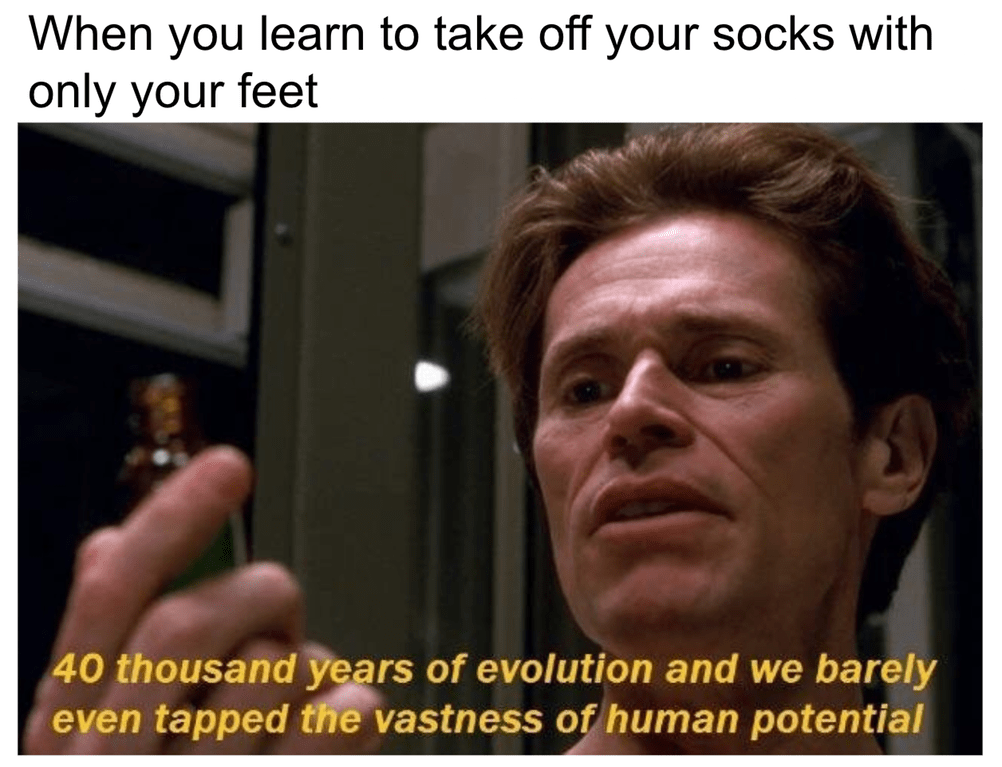
The quality of the movie and its adherence to this theme is consistent throughout, even to the final scene, where Peter accepts his duty to be Spider-Man by telling Mary-Jane that he cannot be with her. This is of course the one thing he wants most, and he can’t even tell her the reason behind his seemingly cold action.
On a personal note, this is also one of the first movies I can remember where I was old and mature enough to recognize contemporary symbolism in a film. I don’t mean that I never understood symbolism in movies, but this was when I realized that a movie I was seeing for the first time contained imagery that was meant to evoke contemporary events. There is a sequence at the very end of the movie where Spider-Man is swinging through New York toward some emergency with other emergency vehicles, and at one point he clings to a large American flag. That image of a hero with the flag in the background immediately brought to mind for middle-school George in the audience how this was obviously a response to the 9/11 attacks the year prior in the real-life New York. It was meant to install Spider-Man as a patriotic rallying point Americans could all get behind. Watching the movie recently, I of course am able to see other symbolism, such as the scene in which the Green Goblin is pelted by ordinary New Yorkers who shout “You mess with one of us, you mess with all of us!” in response to seeing Spider-Man in danger (another allusion to the cohesiveness of a post-terrorist attack New York community). Still, even though it’s a small thing, that first realization was a new experience in the moment that I was proud of myself for having.

Spider-Man 2 (2004)
Even today, in the midst of the Marvel Cinematic Universe and all its critically-acclaimed entries, Spider-Man 2 is considered to be one of the best superhero films ever made. A classic example of a sequel building on and surpassing the original, so much has been written lauding this movie that there’s no reason for me to say much.
But I was especially impressed that 2 increases the stakes by including something I don’t see many second entries in superhero trilogies deal with: self-doubt. Yes, lots of superheroes doubt aspects of their super careers at some point – Captain America feels betrayed by modern American espionage in his second movie, Thor feels incomplete and unworthy without Mjolnir in the Avengers: Endgame, Batman is unsure he can live up to the challenge he has given himself in the Christopher Nolan Batman trilogy., and even Tom Holland feels unsure he is worthy of his costume in his Spider-Man movies without his father figure Tony Stark to guide him. But Spider-Man here does something I don’t believe any other hero does. He starts to feel torn between his lives as Peter Parker and Spider-Man so much that actually begins to lose his powers. He’s unable to stop villains because he physically can’t shoot his webs anymore. If he can’t crawl on walls as Spider-Man and he can’t maintain his academic studies or hold down a job as Peter, how can he exist at all?
So he decides to throw away his costume in an alley dumpster and abandon his city, choosing a normal life over a super one. This, of course, gives us the great sequence where Peter, back to wearing his glasses, shows us how happy he is with his simple life in a montage set to “Raindrops Keep Fallin’ On My Head” (of course popularized by Butch Cassidy and the Sundance Kid) in a silly, feel-good resolution to Peter’s decision. But then at the end of the sequence Peter sees a man being mugged in an alleyway calling for help, and while Peter does stick to his decision and turns away, he do so reluctantly and guiltily, which is evident is his expression. Later, of course, Peter realizes (with a pep talk from Aunt May) that Spider-Man is something the city and its people need, including Peter himself, and he puts the suit back on to battle the evil Dr. Octopus. I just think it’s such a different direction to take the “hero has doubts about his abilities” trope. Peter doesn’t just ruminate on some abstract idea of not being good enough; he actively throws his superhero life away. It’s a direction superhero audiences (at the movies, at least) aren’t used to.
As I mentioned, there’s so much more to be said about other aspects of this superb superhero movie: the complexity of Dr. Octopus, another villain whose scientific aspirations get the better of his humanity; the revelation to Harry Osborne that Spider-Man and Peter are the same person and its effects on the eventual reemergence of the Goblin; the fantastic Christ-imagery of Peter’s fight with DR. Octopus on the train after Peter almost dies saving New Yorkers; Peter’s attempts at a normal life and the ways in which he spectacularly and sometimes hilariously fails.
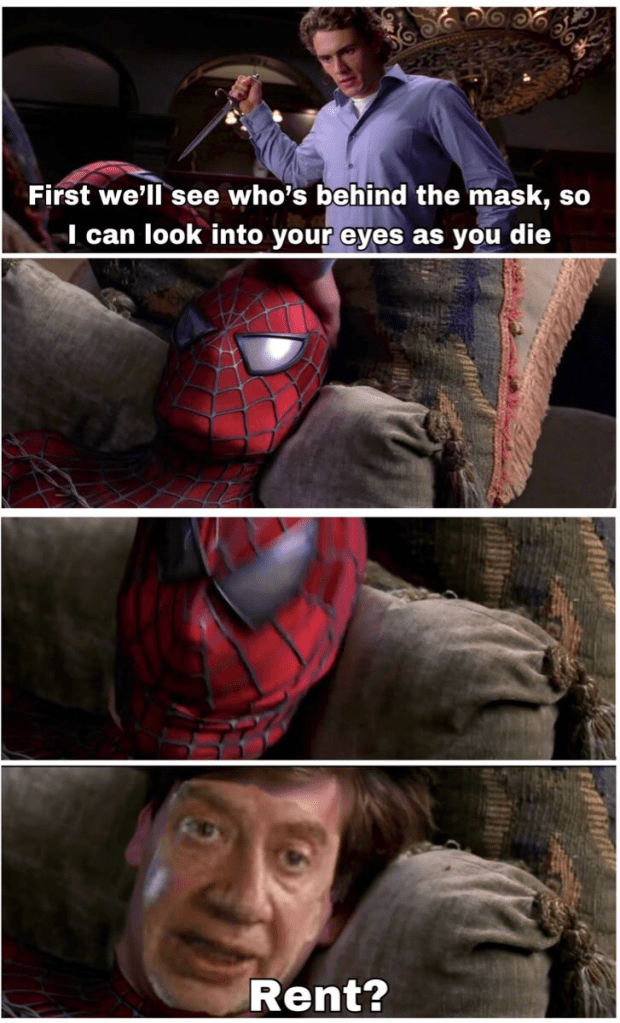
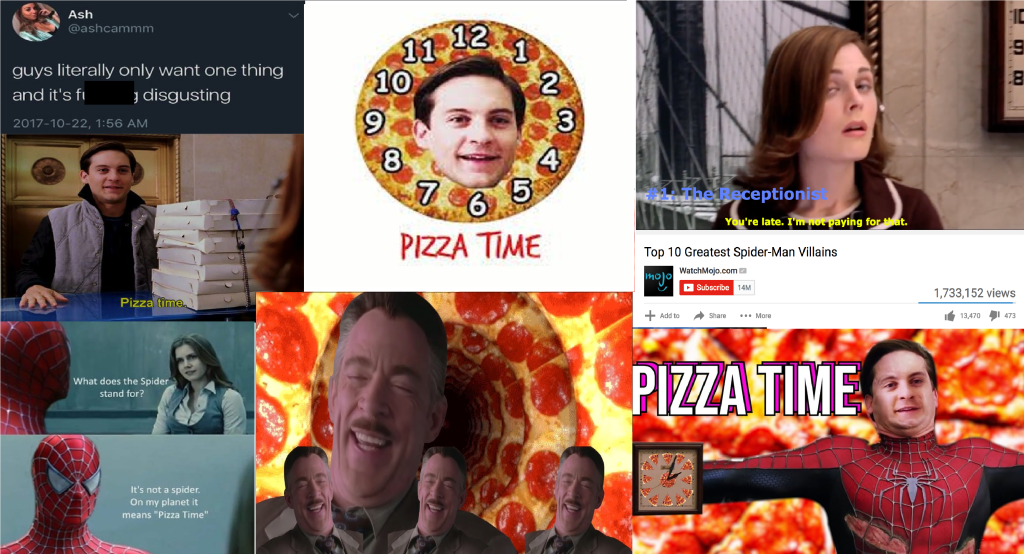
Or how this entry, the most-memed film of the three, gave birth to what was one of the most popular online meme references for years. There is a scene early on where Peter, trying to keep his job as a pizza delivery boy, announces to a customer that he has completed his delivery and that it’s “Pizza Time.”
These two words have spawned an extremely large number of referential Internet memes from a movie, second perhaps only to the Star Wars Prequels or The Room. They range from relatable…
to silly…

to crossover memes…
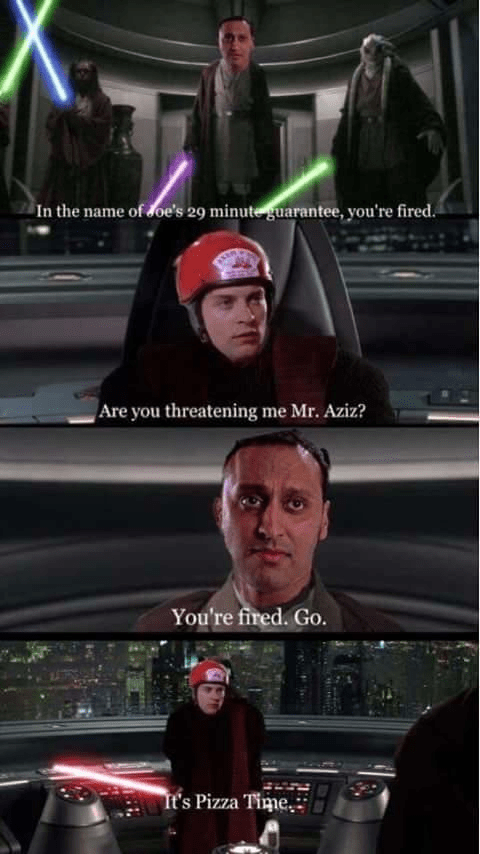
to every absurd point in between.
In addition, the movie tie-in video game of this movie featured an entire mission in which you deliver pizza, and took a well-known classical Italian song and turned it into a war crime.
Oh, and it won an Academy Award for Best Visual Effects.
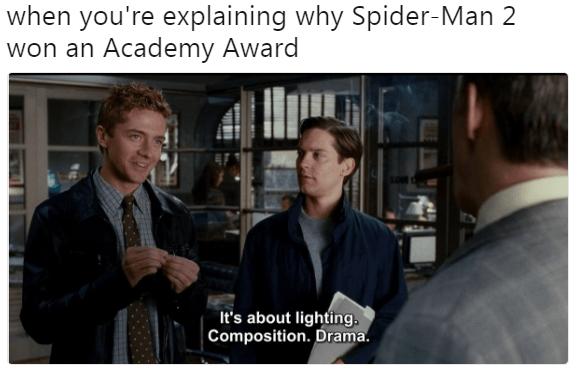
In short, this film deserves all the praise it received, and you should watch it again.
Spider-Man 3 (2007)

Spider-Man 3 is infamous being seen as a let-down for the fans of this trilogy, and this is what I would like to speak to. The most-cited reasons for this disappointment are that there are too many plots presented in the film, so that instead of one cohesive story we are left with many half-baked ones. Despite my feelings that this movie has garnered an unfairly negative reputation over the years (an opinion which was reinforced with my recent re-watch), there is actually a good point to be had here.
The reason this film feels like there’s two movies’ worth of content squeezed into one is because that is exactly the case. As you can read in more detail here (or in funnier detail here), director Sam Raimi basically had a plan to make third and fourth Spider-Man films with their own well-paced stories, but was forced to include more and more content by executives at the studio. When 3 was released to less-than-stellar reviews (although an obscene amount of money for the time), Raimi was asked to continue with his planned fourth film. In an act that I find highly respectable for an industry seemingly eager to churn out sequels just for money, however, Raimi decided to part amicably with Columbia Pictures and Marvel because he didn’t feel the story he was creating was good enough to do the franchise justice. This is such a shame, especially considering that several of the ideas that have surfaced over the subsequent years sound very interesting, including a father-daughter villainous duo of classic Spider-Man villains Vulture and Vultress, as well as a more satisfying finale to Peter and Harry’s relationship. The fact that the Spider-Man franchise was immediately rebooted after Raimi’s departure speaks to why I respect Raimi’s creative decision so much.
There is also the fact that Spider-Man briefly becomes evil in this film after being exposed to an evil entity from outer space called the Symbiote, and Peter turns into a dancing emo douche that grates on audiences. But in defense of the movie, I would like to point out something I think everyone forgets: that “Symbiote Peter Parker” is SUPPOSED to be cringy and unlikable. The movies points out that the Symbiote amplifies traits like aggression and anger (and, unofficially, douchebaggery), so why is it a surprise that Peter isn’t immune to its effects before he is aware of the Symbiote’s true nature? I understand that not everyone has the same tastes, but I just find that such a weird criticism of the film overall when that’s literally supposed to be that way.
And yet, if modern memes are anything to go by, these and other moments are still culturally-relevant enough to be kept alive in the consciousness of the Internet to this day. It seems, like pineapple pizza, sometimes people don’t like good things simply because they don’t think they’re supposed to. So maybe people are coming around to my way of thinking.

Again, there are so many good things to dissect about this movie. However, in this case, I’d rather encourage you to see them again for yourself rather than point them out here. At the end of the day, I guarantee it isn’t as bad as you think you remember.

Before we leave this fantastic and landmark trilogy behind, I wanted to remind myself why I’m watching these movies in the first place. When I started this series looking back at the pre-Iron Man Marvel film catalog, I was searching for something specific to these older movies that distinguished them from the modern MCU. Much and more has been written about how a large part of Marvel’s success is due to the consistency of its tone across all its movies, so it’s worthwhile to compare the tone of these other movies to that of the MCU. In my introductory post to this series, I quoted a movie review of Fantastic Four (2005) that I thought touched on how I felt about these 90s and 2000s superhero movies:
“The film didn’t strike me as having, as they say, pretensions. It was what it was—a live action comic book. That it was not more, that it did not elevate the genre in the process of transferring it to a different medium, may be true, but if that is the worst thing you can say about it, then I’m not sure where all the hostility is coming from.”
These Spider-Man movies are the epitome of comic-book adaptations, in my opinion. As we’ve seen, they feature some of the best casting choices in superhero movie history relative to the source material, as well as seamlessly blending the “super” elements of the story with the “real world” in which they take place. These movies are to superhero adaptations what Peter Jackson’s Lord of the Rings trilogy is to book adaptations: just about the best we are going to get. I’m definitely looking forward to finishing my list of movies, but this trilogy sets the bar for the tone I’ve been looking for. There will be plenty of time to compare these films and their tone to that of the MCU as a whole at the end of this series. With that in mind, let me leave your with the opening theme for these movies by composer Danny Elfman, which I think ties together this great and influential trilogy.
Speaking of the Fantastic Four film, it and its sequel will be the subject of our next entry in the series. Hoping everyone is staying safe and away from other people.
 Culturally Opinionated