
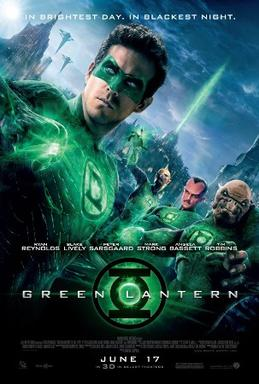
Well, we’ve finally reached the end of our series revisiting some of the movies that defined the superhero genre before the MCU juggernaut changed the landscape. Normally, we would save the best for last; that is not necessarily going to be the case here. Finishing up our roster of movies we will look at perhaps the most infamous entry on our list: Ryan Reynolds’ famous flop Green Lantern.
By 2011, superheroes had been firmly established as a sure-fire money maker for Hollywood. Both the X-Men and Spiderman had movies that made them household names in households that didn’t read comics, and the Dark Knight trilogy had brought Batman back from the disastrous Joel Schumacher era of the late 1990s. And though the true legacy of Iron Man would not be fully realized for several years, the movie itself was both popular and profitable. But Hollywood had also realized that superhero films could lose money as well. Some of the biggest box office flops of the genre were released during this period. It isn’t all that surprising, when you think about it. Especially in pop culture, when one person or company comes up with a popular, money making idea, it inevitably follows that low-quality imitators will flood the market trying to hitch a ride on the coattails of those more successful than them. For every Jurassic Park, Night of the Living Dead, and Jaws, there are a couple hundred Cowboys vs. Dinosaurs, Zombeavers, and Sharknados (1-5) to cash in on a good idea. Whether it was intended this way or not, Green Lantern unfortunately comes across more as one of these cash grabs.
Green Lantern features prominently on listicles and videos across the Internet as one of the worst superhero movies ever made. I disagree with this categorization. It’s certainly on the lower end of the spectrum of “Superhero Movie Quality” (with The Fantastic Four (1994) at one end and The Dark Knight at the other). But there are movies even in this genre that are more deserving of the bad reputation the movie has received. In my opinion, Green Lantern suffers from two main issues. First, that it is a mediocre superhero movie that was released too late for its “superhero formula” to be interesting anymore; and secondly, that there are too many things being crammed into it.

First, a brief background. The term “Green Lantern” refers to both the superhero who protects Earth (or more accurately, the sector of the universe Earth resides in) as well as the organization that hero is a part of, the Green Lantern Corps. Each Lantern is given a ring that is powered by two forces. First, the ring only comes to beings with great power of will, who can then use the ring to manifest their thoughts into physical forms for combat. As one of the characters remarks in the film, “Your will turns thought into reality. To master the ring you must learn to focus your will and create what you see in your mind. The ring’s limits are only what you can imagine.”
In the film, this translates to alien minds creating complex, non-Euclidian shapes…

and the human Lantern, Hal Jordan, making guns.
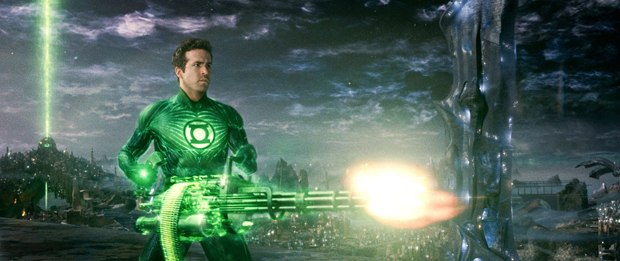
The second thing that charges the rings is literally a battery in the shape of a green lantern, which itself needs to be charged by an even bigger battery in the center of the planet that houses the Green Lantern’s headquarters, Oa.

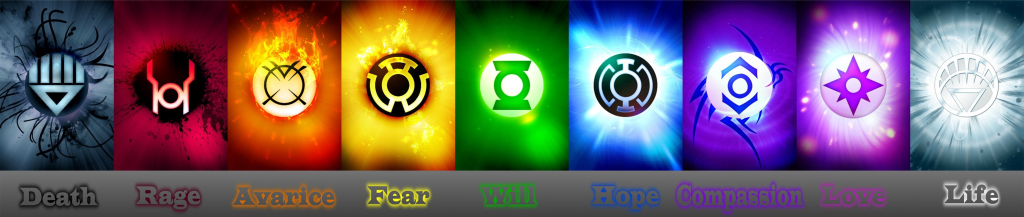
Now you may be asking: why the Green Lanterns? Well, because the color of will is green.
(Ryan Reynolds) “What’s with all the green?”
(Tomar-Re) “Green is the color of will.”
Obviously.
Besides, all the other colors were taken.
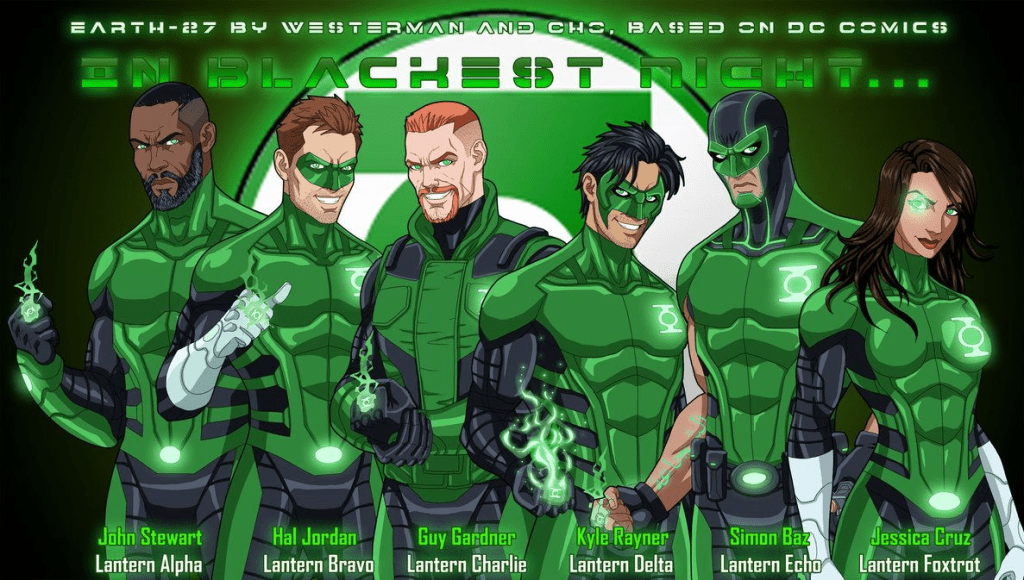
There have actually been several Green Lanterns protecting Earth throughout the years. In the film, we follow perhaps the most famous Lantern, Hal Jordan.
Hal is a test pilot for the Air Force, your stereotypical hotshot Top Gun pilot who doesn’t play by the rules. His father was also a test pilot who died when Hal was a child in a test accident. One night, Hal is literally kidnapped by an errant Green Lantern ring who transports him to a dying alien, the ring’s previous owner. In his last moments, the alien bequeaths the ring and its responsibility to Hal. Hal then joins the other Green Lanterns in their fight against the forces of evil in the galaxy, which inevitably show up on Earth to threaten the planet and all humanity.
What I’ve just described seems like a typical superhero origin story movie, a la Spiderman or Iron Man. Unfortunately, that is also only half of the plot. While Hal is dealing with accepting that great responsibility that has come with his new great power, the other Lanterns are fighting against an ancient evil that has been unleashed on the galaxy as the embodiment of fear (which is yellow) named Parallax. Although Parallax is an actual being, he always manifests as a sort of evil yellow cloud with a face as he gobbles up worlds and the fear of their inhabitants through the galaxy. The Lanterns are unable to stop him, and Hal is the one who must save the day.

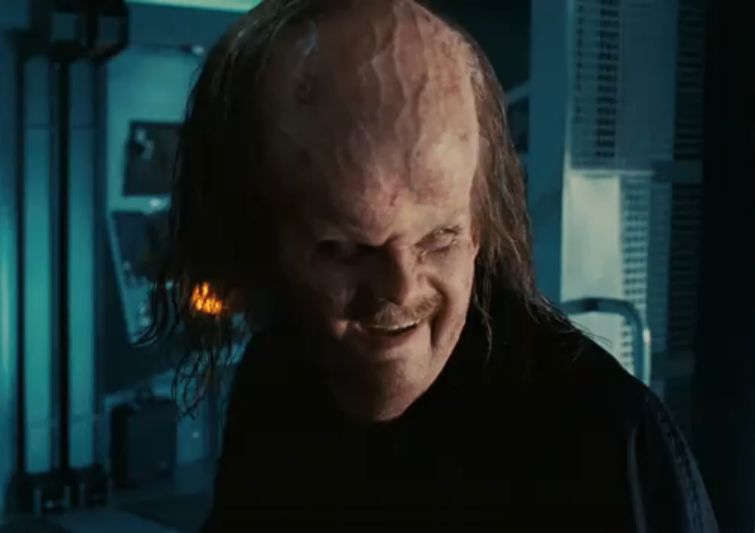
There are obviously more nuances to the plot. There’s a reconciliation with Hal’s love interest. There’s the tragedy of Hal’s friend Hector Hammond, who accidently gets infected by Parallax’s power and succumbs to the power of fear, turning into a Cronenbergian horror before being eaten by Parallax out of spite. There’s a subplot setting up for a never-to-be-made sequel where one of the Green Lanterns, the extremely unfortunately-named Sinestro, forges a Yellow Lantern ring to combat Parallax and becomes consumed by its alluring power over others, becoming the first of the Yellow Lantern Corps. Nevertheless, these are the two main plots of the film. Alone, these would be fine as two separate movies – a classic origin story and later an escalation of threat to test our hero. But like Spiderman 3 before it, Green Lantern flew too close to the sun and crashed under the weight of bad CGI and too many villains.
On a related note, this movie makes some strange pacing choices, specifically that it tends to spend a lot of time focusing on aspects not the most important to the plot. For one thing, the movie spends a very long time following young Hal Jordan in order to set up his insecurities after watching his father die in a test-plane crash. Of course this is sad, and formative to Hal’s character. One of his inner conflicts of the film is dealing with the ring’s decision to choose him when he is still crippled by fear from witnessing his father’s death. But usually these kinds of backstory scenes are just that – one, maybe two scenes. Kid Hal’s role seems to go on and on at the film’s start. Similarly, Hal spends a good amount of screen time on the planet Oa being trained by the Corps. Specifically, he spends a lot of time being shown how to make green weapons with his ring and being told how unworthy humans are to wear the ring. Again, character building, but not the most interesting scenes in a superhero film.

Overall, this movie just seems to want to deliver a big payoff without doing any of the hard work to set it up. To understand what I mean, let’s compare the “bigger setting” of Green Lantern’s cosmic conflict to that of the MCU and the Infinity Saga. By now, we all know that the larger story behind all the smaller conflicts of the MCU’s film catalog concerns the quest of the Mad Titan, Thanos, to locate the six Infinity Stones in order to destroy half of all life in the universe. We learn about the smaller parts of this story slowly, over 10 real years of movie releases. We don’t learn about Thanos until the sixth movie in the series, The Avengers, and even though we see an Infinity Stone for the first time in Captain America: The First Avenger, we don’t learn what they actually are until Guardians of the Galaxy, the tenth film. By the time we actually have a confrontation with Thanos and an official realization of what’s at stake for the universe in Avengers: Infinity War, we’re in the 19th part of a 22-part story. The payoff is so good because of the slow and organic buildup to the story’s conclusion. We’ve had more than a decade to care about the characters and the world they live in, and the stakes feel more real. For a fictional universe, of course.
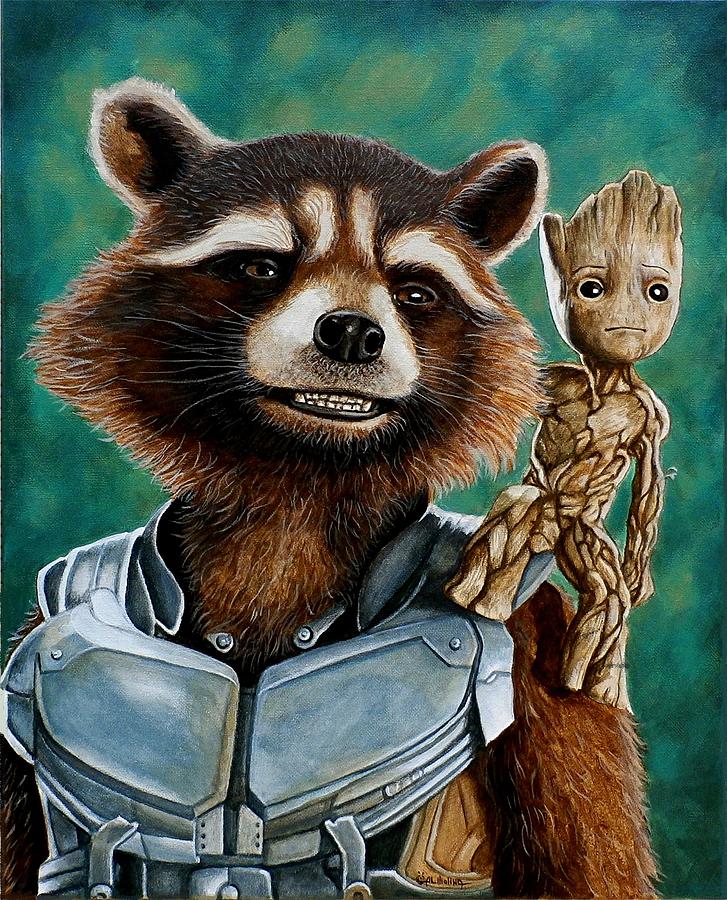
The opening of Green Lantern, on the other hand, immediately throws the audience into decades of comic lore, from the creation of the Green Lanterns at the beginning of time to a great evil threatening to destroy the galaxy to the nature of will versus fear. It feels more like reading an encyclopedia entry on the DC fan Wiki than as the introduction to a piece of entertainment. More effort is put into giving the idea of a huge, storied universe than fleshing out the universe itself. You’re immediately meant to care not only about Hal Jordan and his close friends, but the entire universe as well. Unfortunately, it doesn’t work.
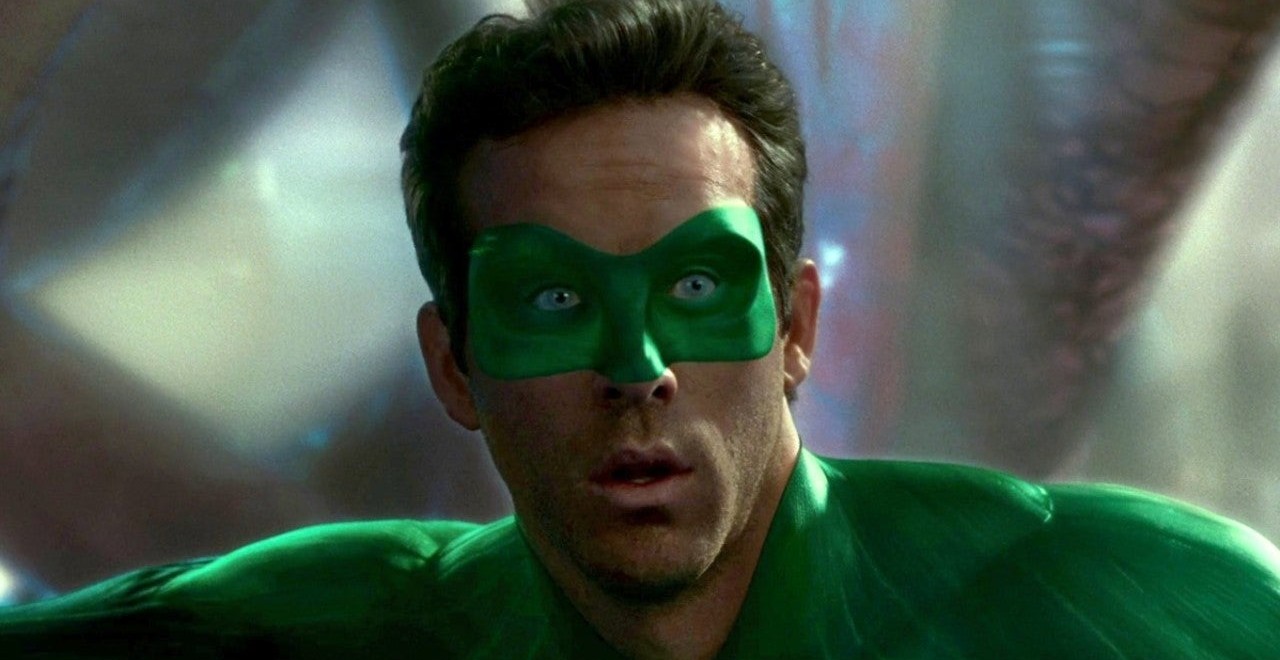
So do I think Green Lantern is so bad that Deadpool needed to go back in time and kill Ryan Reynolds before he starred in it? It’s a funny gag, but no. If this movie had come out five years earlier when the “superhero formula” was still new and interesting, I think we would look back on it more favorably than we do now. Taken in a vacuum, it’s not a terrible film; it’s just one that’s too familiar for most audiences at this point. Ryan Reynolds has redeemed himself in the eyes of comic fans with his portrayal of antihero Deadpool, and DC movies have slowly but surely been improving in quality in recent years. And even though the failure of this movie is probably what had kept Green Lantern himself out of any DC movies since then (including a film about the Justice League, of which Green Lantern is a founding member), I think enough time has passed that audiences are ready to be reintroduced to the mythology of the Green Lantern Corps. Hopefully this time it’s a more gradual introduction.

So whenever it is that DC releases their next movie about the Lanterns and it’s so enjoyed people rush out to buy every green piece of merchandise they can get their hands on, remember the Green Lantern Corps oath and brag about how you liked the hero before it was cool.
In brightest day, in blackest night,
No evil shall escape my sight.
Let all who worship evil’s might
Beware my power! Green Lantern’s light!
And with that, we come to the end of our Super Cinema Series that started close to two years ago. I’ve enjoyed revisiting some of these movies and seeing some of them for the first time, and I hope you’ve enjoyed taking the trip with me. Despite what some naysayers might think, I doubt the superhero movie bubble is likely to burst anytime soon. Hopefully we’ll continue to be both culturally enriched with elevating stories of super beings and disappointed by baffling choices made by directors and studio executives for many years to come. And if you take nothing else away from our time together, let it be this: Please keep paying to see these movies. Buy merchandise. Take a trip to Disneyworld. Make your kids be Batman for Halloween. Do your part to help these corporations stay obscenely wealthy.

 Culturally Opinionated