
The Resident Evil series is one of the most influential video game franchises of all time. The first title in the series, released in 1996 and simply called Resident Evil, broke ground as the first in a new genre of “survival horror” games. Players control characters who are thrust into dangerous scenarios fighting zombies and bio-organic weapons (B.O.W.s), creatures that have been experimented on and augmented into living killing machines. Players are also given limited resources to fight these creatures, such as scarce ammunition, to enhance feelings of helplessness and anxiety. The goal of the player is to find less forceful ways of surviving the horror they find themselves in. In the 25 years since the first game’s release, 23 other games (as well as numerous movies, books, stage productions and other media) have made the series an international hit with a loyal fanbase.
The main villain of the series is the sinister Umbrella Corporation, an international pharmaceutical company which secretly conducts research to create B.O.W.s using viruses. They then sell these weapons to governments and individuals alike for use in biological warfare and terrorism.

The original Resident Evil introduced a simple concept: players found themselves in an isolated mountain mansion filled with zombies, traps, and terrible acting.
Since the first game, the overarching story of the series has become more complex and grown to include a diverse cast of characters. Numerous government agents, soldiers, and unlikely heroes overcome terrible odds in order to stop some inhuman menace. Equally as memorable as the game’s heroes are its villains. Each game features one or more human antagonists, usually connected to Umbrella, who set the horrific events of the game in motion. In nearly every instance, these villains eventually become exposed to the viruses they create, which causes them to mutate into dangerous monstrosities that must be defeated by the heroes (and by extension, the player).
But why do these villains choose to infect themselves with dangerous viruses? And are the viruses themselves to blame for the atrocities committed by these characters? On the surface, the explanation is related to the escalation of conflict through the game’s story; players begin fighting relatively weak enemies, and by the end of the story must fight an enemy whose power matches or even surpasses their own. Looking deeper, however, the repeated use of this trope explores ideas about the acquisition of power as well as its cost.
The villains of the Resident Evil series can be divided into two categories based on their relationships to their infection with various viruses – those who infect themselves, and those who are infected by others or by accident. The motivations for their infections can be further subcategorized, as we will see. Beware of spoilers for all of the series’ main titles.
Those Who Infect Themselves
Superiority Complex
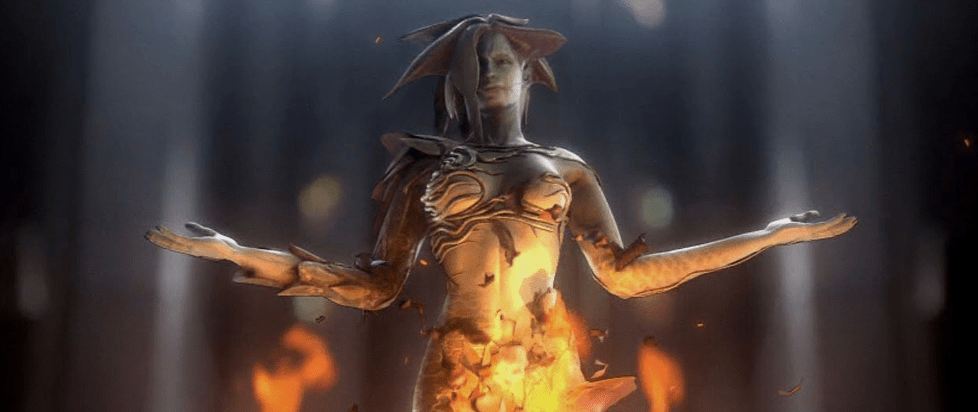
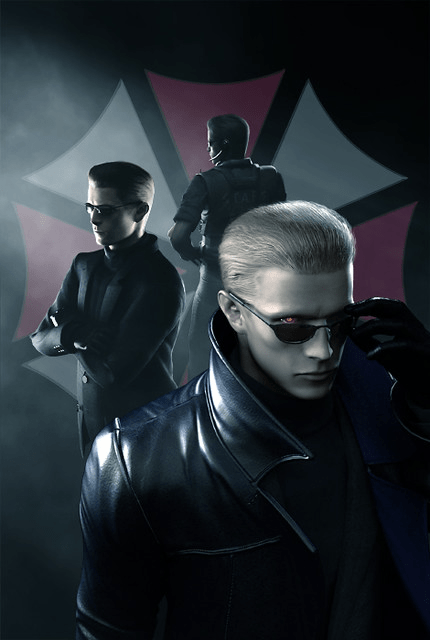
Several of the series’ most memorable villains begin their lives as brilliant and charismatic figures who are told early on that they are superior to those around them. Some of these figures are even created to be superior through genetic manipulation as the result of eugenic research. The main antagonist for many of the series’ games, the brilliant and deadly Albert Wesker, was raised as part of a eugenics test program designed to create more perfect humans. He and his “siblings” were conditioned to believe that humanity was an evolutionary “dead-end” in need of order, deliverance, and rebirth that only a genetically superior human like himself could provide. As a result, Wesker spent his life searching for a way to claim what he felt was his rightful place over all of humanity. His employment by Umbrella, Inc. allowed him to find ways to genetically manipulate and weaponize viruses that would make typical humans physically stronger and, to in his mind, more deserving of survival; his betrayal and direct hand in destroying Umbrella then gave him the monetary means to realize his plan. To this end, he voluntarily infects himself with one of Umbrella’s creations, the T-Virus. Not only is he able to control the virus’ influence over his body due to the manipulation of his genes in childhood, he is also granted increased physical strength and speed as a result, reinforcing his belief that he is a superior being.
Other villains, such as Resident Evil: Revelations 2’s Alex Wesker (Albert’s “sister”) and RE – Code: Veronica’s Alexia Ashford are similarly raised to believe they are superior to the rest of humanity, and that only through power can they assume their rightful place as rulers of the world. Both use their intellect to create viruses that imbue them with tremendous physical power. RE 4’s villain, the cult leader Osmund Saddler, has similar aspirations of world domination. He injects himself, his followers, and his victims with a parasitic organism, and uses its power to force its victims to do his bidding. Everything these villains do is in service to their goal of transcending the “inferior” humanity they are born with and attaining the power to control or destroy others that only they deserve.
Attaining this power comes at the cost of their physical appearance. The respective viruses and parasites these villains expose themselves to warp and malform their human bodies. Due to their superiority complexes, however, these villains tend to view these mutations as the next logical stage in the evolutionary process and welcome them. As their intellect transcended the undeserving humans around them, so they now transcend their weak human bodies and become a more perfect being. Albert Wesker exposes himself to yet another virus, the Oroborus virus, and becomes almost unstoppably strong. Alex Wesker tries to cheat death first by injecting herself with her own virus that activates when the victim experiences fear, the T-Phobos virus, and then later by transferring her consciousness into another’s body. Once her preparations are complete, she plans to do away with her old body to prepare for “immortality;” in the moment before she shoots herself, however, she experiences an instant of fear at her impending death, and the T-Phobos virus inside her activates, transforming her into a repulsive monstrosity.
More often than not, however, these monstrous transformations are their undoing. In typical video game fashion, these new forms feature large “weak spots,” usually giant fleshy wounds or staring eyes, that the heroes can exploit to put down their megalomaniacal foes. In attempting to shake off their human forms which they perceive as a weakness, they leave themselves vulnerable. Though it takes great struggle, and in Albert Wesker’s case an active volcano, they are always defeated by the heroes working together against a selfish lust for power.
Revenge
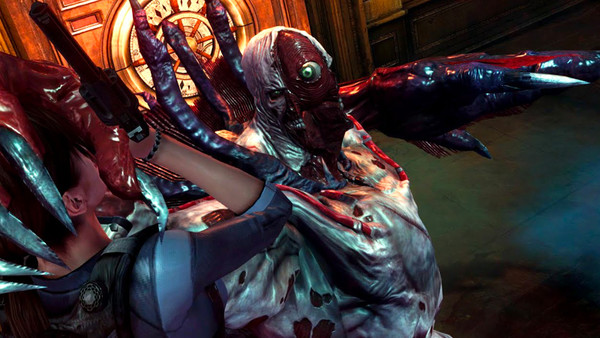
Other villains see the virus as simply a means to an end. RE 6’s Carla Radames and RE: RE: Revelations’ Jack Norman are both betrayed by the organizations that employ them. Once learning of their betrayal, both make use of viruses at their disposal to grant them the power to destroy those who have wronged them. They experience varying degrees of success. Though Carla Radames is able to infect her former employer and betrayer, Derek Simmons, with a painful and deadly form of the C-virus she infects herself with, she herself is killed before seeing him meet his end. Bioterrorist Jack Norman is trapped deep underwater in a submarine as a result of the events of his betrayal and attempts to use a sample of the T-Abyss virus he once used to kill innocents to grant him power to break free of his prison and kill his betrayers. He is killed by the story’s heroes before his mindless rampage can claim any further victims. Both welcome the physical, monstrous changes their respective viruses provide, but only as a means to the short-term goal of getting revenge.
For Power’s Sake
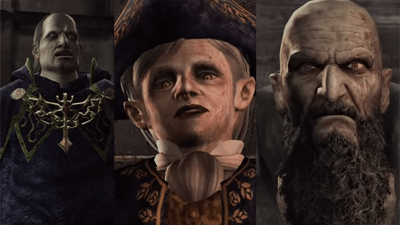
A larger number of villains expose themselves to various viruses and parasites for a much simpler reason. Though they similarly want power, they have no grand aspirations of world domination or attaining the next stage of human evolution. Rather, they desire power simply for power’s sake. Frequently, their transformations occur when they are cornered by the game’s protagonists, using the raw power granted to them by the virus to escape arrest. RE 5’s Ricardo Irving and RE 7’s Lucas Baker are low-level criminals who attempt to evade law enforcement by attacking longtime series hero Chris Redfield (who kills them both). RE: Darkside Chronicles’ Javier Hidalgo and RE 5’s Excella Gionne head criminal organizations that deal in B.O.W. distribution, and “get high on their own supply” to avoid being captured by anti-bioterrorism forces. Both influential castellan Ramon Salazar and village chief Bitores Mendez willingly accept cult leader Osmund Saddler’s “gift” of the Las Plagas parasite in RE 4, using its power to control those underneath them but with no aspirations other than to serve Saddler’s desires. And though Colonel Sergei Vladimir is loyal to the Umbrella Corporation he serves, his ultimate goal is to use their research to restore the glory of the former Soviet Union on the world stage, and takes a variation of the T-Virus to this end.
These villains are almost always aware of the transformative properties of the viruses they deal in and usually torture others with. However, their desire to survive or prove themselves to others through brute force overrides their common sense, and they embrace the destructive power given to them by their viruses. Their monstrous forms still end up betraying them, however, and the weaknesses of their new forms are easily exploited by the heroes.
Those Who Are Infected by Others or by Accident
Revenge
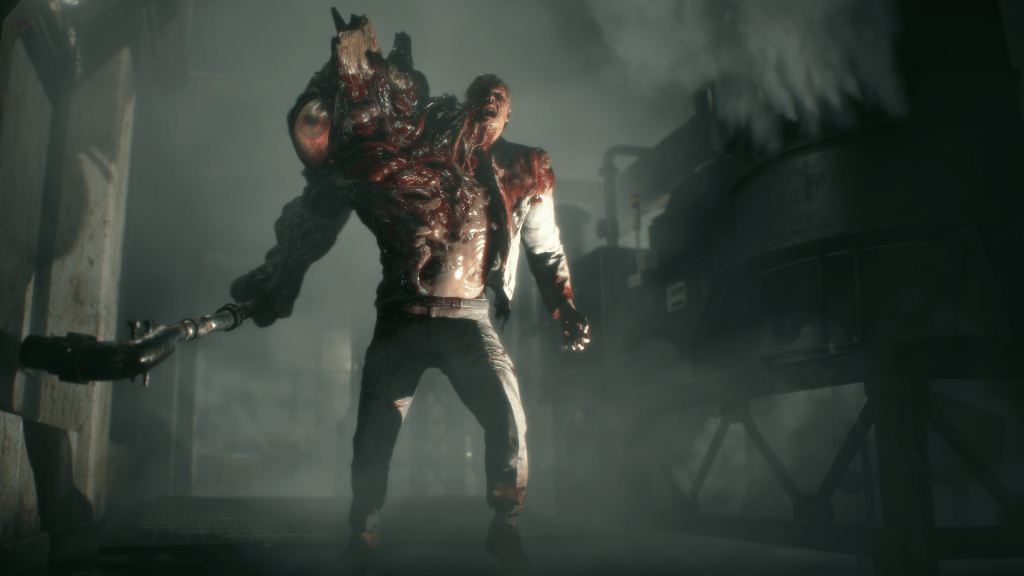
While most of the series’ antagonists set out to gain power for themselves and take over or destroy the world, other villains are victims of unfortunate circumstance. In RE 0 and RE 2, both Umbrella co-founder James Marcus and Umbrella scientist William Birkin are killed by Umbrella forces who wish to steal their research on various viruses and their weaponization, respectively. As he lays dying, Marcus’ prized research specimen, a queen leech genetically modified with Marcus’ T-Virus, enters his dead body and fuses with him over many years. Absorbing Marcus’ memories and believing itself to be Marcus reborn, the new Marcus commands armies of mutated leeches to take revenge on Umbrella. William Birkin develops a more powerful version of the T-Virus, the G-Virus, and plans to defect from Umbrella to the US government. When Umbrella learns of this, they send a hit squad to kill him and take his research. As William lays on his deathbed, he infects himself by accident with his G-Virus. His horrific mutation and ensuing murderous rampage against Umbrella’s forces end up accidentally contaminating the water of nearby Raccoon City with the T-Virus, directly leading to the city’s inhabitants becoming zombies and the city’s eventual destruction by US forces to contain the outbreak. In RE 6 US National Security Advisor Derek Simmons uses bioterrorism to make the world more dependent on US power and employs a colleague, Carla Radames, to oversee his plans. When Radames learns of Simmons’ plans to betray her, she infects him with her C-Virus, causing him constant and agonizing pain as the result of its mutative powers. An enraged Simmons uses his new transformative abilities to search for Radames and kill his one-time ally.
All of these men suffer first betrayal and then horrific transformations. Though their associations with bioterrorists and evil corporations cements them as villainous, the loss of their humanity to their respective viruses could be considered almost tragic. However, all three also decide to use their new-found power not to atone for their mistakes or save innocents, but to take selfish revenge on their enemies.
For Power’s Sake
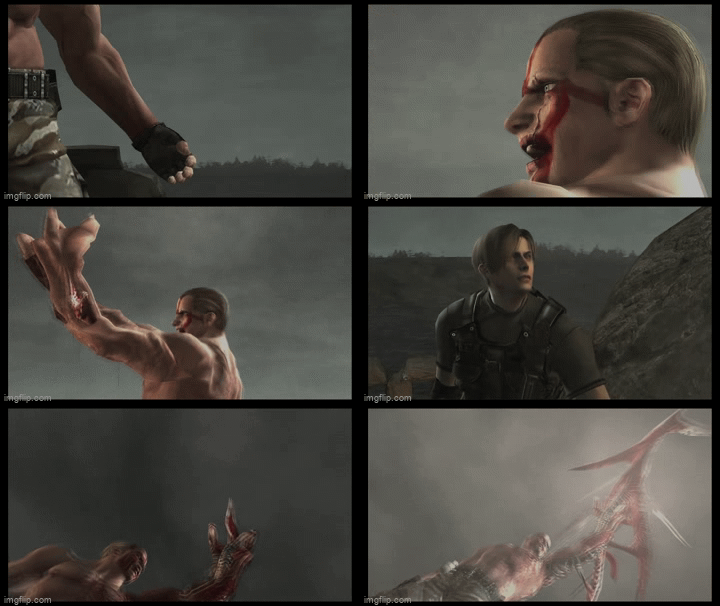
RE 4 villain Jack Krauser is turned to evil by his accidental infection. In RE: Darkside Chronicles, we learn Krauser and series hero Leon Kennedy were US operatives working together to fight bio-terrorism. Krauser’s entire identity revolved around being a good soldier, and his devotion made him deadly. On a mission to stop drug lord Javier Hidalgo, Krauser is wounded during a fight with a monster and is infected with the T-Veronica virus. By the end of his mission, Krauser realizes two truths: first, that his injury will end his military career and leave him purposeless; and second, that the virus now coursing through him will allow him to become a more powerful and deadly soldier than ever before. He seeks out ways to refine his abilities, eventually falling in with cult leader Osmund Saddler in RE 4. Krauser’s devotion to being a deadly and effective soldier were used in service of protecting the people and government of the United States. After acquiring the virus’ new and intoxicating power, however, Krauser’s decision to apply his deadly trade in selfish pursuits led him to a villain’s life and a villain’s ignominious end. His reunion and confrontation with Leon in RE 4 ends in Krauser’s death.
Created as B.O.W.s
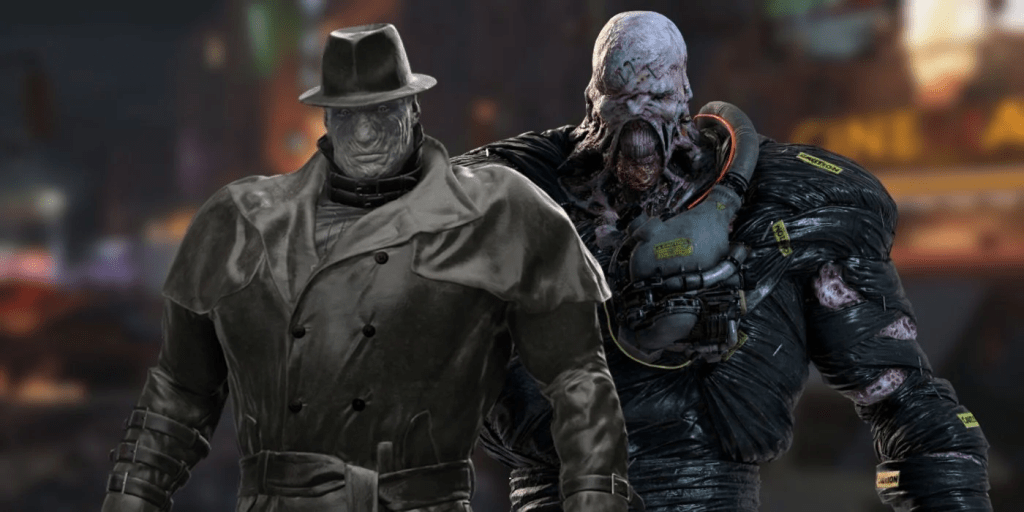
Unique among the notable villains of the Resident Evil series are those who are specifically created to be weapons by scientists of Umbrella and others. Research of how the Umbrella-created T-Virus interacted with human test subjects eventually led to the creation the Tyrant “supersoldier” series, named after the virus which created it. Though the first Tyrants were considered failures, the project eventually became viable with subsequent Tyrants that were usually cloned from samples of the first successful specimens. Two named Tyrants, RE 2’s Mr. X and the Nemesis from RE 3: Nemesis, cause mayhem and terror in Raccoon City during its zombie outbreak. They are relentless in their pursuit of the heroes of their respective games, relying on intelligence and their immense strength to overcome nearly any obstacle. It is only through much effort and substantial firepower that they are eventually killed.
Similar to the Tyrants is RE 7’s Eveline. Eveline is developed in a lab as the first of the “E-series,” a new kind of bioweapon. Designed to appear as a young girl in order to avoid suspicion, the E-series would infiltrate enemy strongholds and then use mutagenic fungal spores to invade the minds of its victims, allowing them to control entire armies through her influence. Eveline herself was obsessed with the idea of having a family of her own, most likely the result of being grown and raised in a lab. When the ship transporting her sank near the Louisiana coast and she was rescued by the kindly Baker family, Eveline used her powers to take control of her victims to fulfill her fantasy of a family. Her reign of terror of the Bakers led to the deaths of many unfortunate victims and the creation of horrible fungus monsters called Molded. She was only stopped when hero Ethan Winters destroyed her through use of the E-necrotoxin, a safety measure invented by Eveline’s creators.
Being cloned or grown by science might elicit a measure of sympathy for Eveline and the Tyrants. Brainwashed and molded since “birth,” it might be argued that these creatures had no choice in whether to use their powers and abilities for good or evil. Nevertheless, these living weapons possessed some degree of intelligence and rationalization capabilities, even developing vendettas against those who harmed them previously. This is especially true of Eveline. All intentionally killed and spread terror in their respective rampages with full knowledge of their actions. This, along with their body counts, lessens any potential feelings of pity one might feel toward them.
True Victims
One last notable category of Resident Evil villains concerns those who are truly victims of their circumstances. When any of the various viruses throughout the series turn their victim into a zombie, the new creature has no sense of self left. They are typical, brainless zombies. Even the Las Plagas parasite of RE 4 completely overtook the personality of its victim, despite leaving their basic motor functions, the ability to speak, and follow orders. Occasionally, however, victims are left with their personalities intact. They are forced to watch their bodies do horrible things with no control over their actions.
In RE – Code: Veronica, affable protagonist Steve Burnside is taken prisoner and mutated into a large and violent monstrosity. He is forced to attack his partner Claire Redfield despite his verbal protestations, nearly killing her. Steve manages to regain control of his body just long enough to cause his own death, stopping himself from committing any more atrocities.
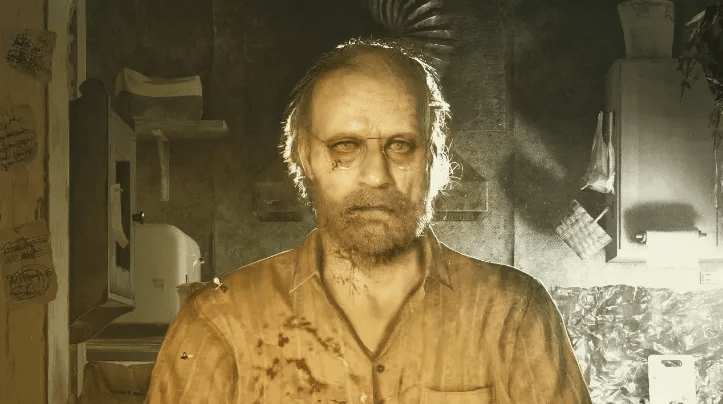
RE 7’s Jack and Marguerite Baker are similarly prisoners of their own bodies. Under the control of bioweapon Eveline’s spores, the husband and wife can only watch in horror as their bodies are compelled to do terrible things to strangers. Marguerite’s body becomes a living hive for horrific insects, and Jack’s regenerative powers allow him to be killed over and over again with no hope for the escape of death. Their bodies are no longer their own. During a sort of dream sequence, Jack’s true self even begs protagonist Ethan Winters to kill him and his wife in order to save their souls from their nightmarish existence. They are finally freed when Ethan destroys their bodies and Eveline herself.
Though they aren’t necessarily “villainous” in the same way as other series antagonists are in that they have no evil intent, the monstrous beings these victims become nevertheless cause death and destruction as a result of their exposure to various contagions.
Power and Corruption
The villains of Umbrella and other similarly-minded organizations view humans as imperfect. They almost always hold a supremacist worldview, believing their intellect or status makes them inherently better than the rest of humanity. Even the few villains who are infected against their wills or by accident decide to embrace their new-found power for self-serving reasons and devolve into killing machines. These scientists and corporations manipulate and distort nature with the ultimate goal of creating a method of transcending the weaknesses of humanity. The result of this quest to become “transhuman,” however, always ends the same way. Instead of improving their human form or getting rid of the weaknesses inherent in it, the villain ends up becoming monstrosities who loses any semblance of humanity altogether.
The moral of the series, therefore, seems to be a cautionary one. Cooperate greed combined with unrestrained, unethical science leads to the dehumanization of those involved, turning them into beings stripped of free will. Attempting to better the human experience by creating life-saving drugs or better prosthetics is an acceptable pursuit, admirable even. Attempting to shed what makes one human and transcend the fetters of human existence is foolish at best and dangerous at worst. The only result is to become monstrous.
It is also important to note that, while the viruses distort and mutate the physical appearances of their victims, they conversely do not change personalities or their motivations. The villains who willingly inject themselves already believe themselves superior to other beings. Their horrific yet powerful mutations act to reinforce these delusions.
Conversely, this power can also reinforce heroic tendencies as well. In RE 6, anti-bioterrorism agent Piers Nivans is mortally wounded during a fight with a giant B.O.W. Seeing his partner Chris Redfield is in danger, Piers injects himself with a dose of the C-Virus to save his commanding officer. Half of his body mutates horribly in the process, giving the duo enough power to defeat the giant creature. Unlike similar characters who voluntarily infect themselves, however, Piers does not give in to fantasies of conquering those weaker humans around him. When the time comes for the pair to escape a crumbling underwater facility, Piers refuses to go with Chris back to civilization in order to ensure no one else becomes infected with the virus he carries within him. The loyalty, bravery, and sense of duty that made Piers heroic in the fight against bioterrorism is amplified by the virus’ mutations to his body. Rather than corrupt his selfless personality, the power given to Piers allows him to save Chris and millions of other potential victims.

Similarly, in RE: Darkside Chronicles, Manuela Hidalgo uses her extraordinary powers for good instead of giving in to evil. Manuela is born with a terminal illness and is told early on she doesn’t have long to live. Her father, the drug lord Javier Hidalgo, uses his resources and wealth to give his daughter regular injections of the t-Veronica virus in order to save her life. An unintended side effect is that the virus constantly destroys Manuela’s vital organs. To solve this, Javier’s men abduct hundreds of young girls in order to harvest their organs, regularly replacing Manuela’s organs with theirs. Growing up, Manuela has no knowledge of this. When Manuela eventually learns where her “donors” come from, she is horrified. Instead of allowing herself to be consumed by grief or succumb to the virus in her, however, Manuela takes charge of her own life and uses the power of the virus to help end her father’s reign of terror.
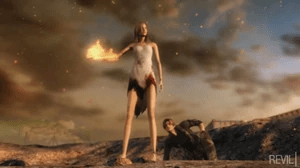
Both Piers and Manuela use their unfortunate circumstances to help others at the expense of their own well-being; their respective viruses simply allow them to do this better than they otherwise could have. This further condemns the villains of the series for their abuse of the viruses they create. The power they gain from infection only feeds this superiority complex. Again, the series affirms that success comes from embracing humanity instead of abandoning it. Physical augmentations only supplement what traits a person already has inside them.
The Fear of Losing Your Self
All good horror stories address an anxiety present in the culture that created them. Part of the anxiety addressed by the Resident Evil series comes from the experiences of its creator, Shinji Mikami. In the article “Fear of a Transhuman Future,” author Jonathan McCalmont identifies the conflicts of the series as responding to a specific social fear, much in the vein of George Romero’s Night of the Living Dead or F.W. Murnau’s Nosferatu.
“The series’ first five games slowly unravel a corporate conspiracy that lead to the leaking of several deadly mutating viruses that cause their victims to turn into zombies (or worse). However, by the time all the facts are divulged in the 2002 prequel title Resident Evil Zero, it is clear that there was no conspiracy to release the viruses. Instead, the outbreak was caused by the systemic failure of corporate salarymen to take responsibility for their actions. Indeed, Mikami seems to see corporations as entities that strip people of their humanity – a humanity that is expressed through initiative, creativity and a sense of responsibility. These are exactly the characteristics he projects onto his cast of protagonists and, by extension, the players.”
McCalmont, Jonathan. “Fear of a Transhuman Future: Zombies and Resident Evil.” http://futurismic.com/2009/09/16/fear-of-a-transhuman-future-zombies-and-resident-evil/
The Umbrella Corporation of the series does just this. It creates viruses that transform innocent people into literal zombies with no humanity left and creates monstrous killing machines that only exist to destroy. Only by working together and celebrating their humanity are the heroes of these games able to triumph over this unfeeling evil.
In her piece “The Horror of Being Human,” Kaitlin Tremblay argues that the possibility of transformation into something other than human is the true horror of Resident Evil and other franchises, such as the psychological horror Silent Hill series.
“In these games, classifying these humanoid bodies as inhuman monsters justifies them as a vehicle for enacting out a societal violence and fear. This is what makes the slaughter of zombies in Resident Evil horrifying to think of: we are trained to not even consider zombies as humans anymore, despite having been at one point. There is rarely a thought to saving or evading them. The terror of the enemies in these franchises, particularly zombies, is what we are capable of becoming – mentally and physically – and how we can lose what we perceive as our humanity. And with this comes the fear of our seemingly lost humanity being weaponized against us.”
Tremblay, Kaitlin. “The Horror of Being Human.” Unwinnable Weekly, vol. 2, issue 11. pp. 10-15.
The act of seeking transformation and shedding one’s humanity is an action only villains undertake willingly due to their twisted views of the world and their place in it. Becoming physically monstrous and abnormal is synonymous with being evil and the “other.” We are willing to justify violence against inhuman zombies in order to protect what is “human” in us (and therefore “good”). How horrifying is the thought, then, to imagine ourselves succumbing to a change that dehumanizes us to the point of having that violence turned against us. Resident Evil and other works of contemporary horror may express this anxiety in a more interactive form, but this anxiety has lived at the forefront of the human experience for thousands of years.
The Pursuit to Become More
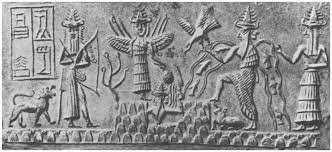
The Epic of Gilgamesh, written almost 4000 years ago, is one of the oldest surviving pieces of literature in the world. It tells the story of the titular demigod king Gilgamesh and his adventures battling monsters and gods in ancient Mesopotamia. At one point during the epic poem, Gilgamesh loses his friend and companion Enkidu to death. He becomes terrified at the thought of his own mortality and spends the rest of the poem searching for a way to stave off his death. Eventually, Gilgamesh travels to the Underworld in search of a magic plant that bestows eternal life. He finds the plant, but before he can use it a snake consumes it, robbing Gilgamesh of his last chance at immortality.
The story of Gilgamesh asks its audience to consider what it is to be human, as well as what it might take to become more than. Gilgamesh strives to become a more perfect being. Despite his failure to attain this goal, the story of his struggle shows us that the idea of becoming “transhuman” is as old as humanity itself. The succeeding centuries are full of literature from around the world about people who strive to change themselves physically or spiritually to achieve a transhuman existence. Some are successful and attain enlightenment, others are not so lucky, and either do not change at all or become monstrous as punishment for their hubris. The morals of these stories vary from culture to culture. Often when a human tries to become more godlike, they find the gods do not share power willingly. Only by achieving great status on Earth or completing some superhuman tasks are heroes successfully granted immortality or some other divine gift.
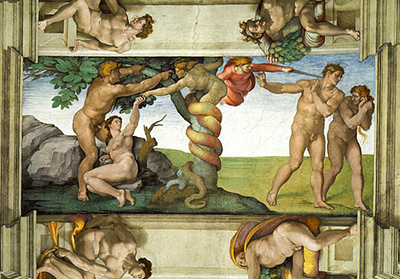
The methods of attaining transhuman status have changed over time as well. In many older stories, immortality or divine power is obtained through magical means, whether granted by the gods or taken from a magical item obtained during a quest. With the advent of modern science, more and more stories feature characters who proactively grant themselves a chance at these transhuman gifts of immortality and awesome power. The Resident Evil series falls into this category.
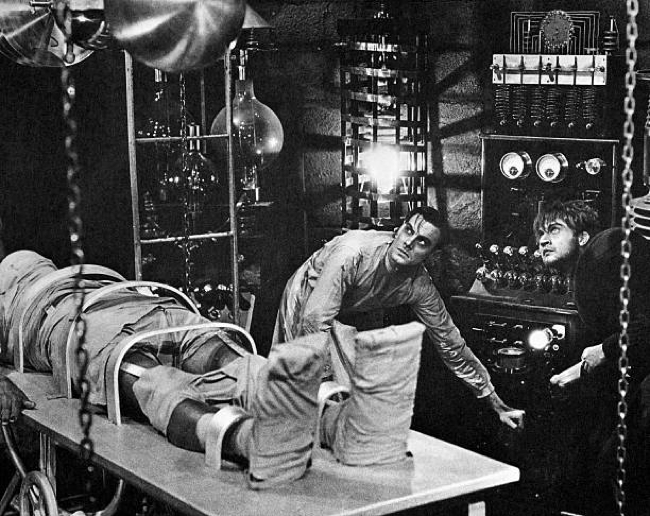
But there has been another notable shift in modern literature as well. In Gilgamesh’s tale, he was the hero of the story and the only one capable of obtaining the magic gift he searched for. The Buddha achieved enlightenment and transcended the painful cycle of humanity and is venerated by millions for it. In the Resident Evil series, as in the majority of contemporary literature and science fiction in particular, the search for transhumanity is instead pursued only by villains and madmen, and only ever ends in monstrous failure. The science fiction tales of the 19th century popularized this idea, with the tragedy and horror of May Shelley’s Frankenstein being perhaps the most famous example. Stories such as The Isle of Dr. Moreau and The Strange Case of Dr. Jekyll and Mr. Hyde introduced us to the mad scientist who tries to defy nature with disastrous results. Films like Blade Runner and 2001: A Space Odyssey as well as TV shows like Star Trekshow us the dangers of trying to play god with our humanity. Our opinion concerning the pursuit of transhuman ideals seems to have changed with the development of our civilization.
Conversely, some would consider modern-day superheroes to be characters who are lauded for their transhumanist actions. Iron Man and Batman use technology to augment themselves beyond their human abilities, and Captain America is injected with a “super serum” to give him his abilities. Despite this, these and other heroes are almost always paired against villains who share similar powers and backstories but who use their gifts for evil. Captain America fights the Red Skull, who was augmented with the same serum, Iron Man fights several villains who made their own super suits, and Batman’s Rouge’s Gallery is full of brilliant minds whose pursuit of surpassing their humanity through scientific achievement led them to lives of crime and insanity. Even Superman, often considered the best of the best, continually strives to become MORE human to better live in his adopted home of Earth. Science fiction and science horror continue to tell stories more as cautionary tales about the dangers of abusing power than inspirational stories of overcoming insurmountable struggles of the past.
_________
Though the Umbrella Corporation and its creations are fictional, the anxieties of the Resident Evil universe are very real. More and more people are becoming aware of the inhumanity with which many real-life corporations and powerful organizations treat their workers and customers in pursuit of a bigger bottom line. At the same time, real-world advances in science and technology are bringing the possibility of physical or even mental augmentation closer and more readily available than ever before. Science fiction is quickly becoming reality. Without some kind of guidance or cautionary tale, change (especially rapid change) can be overwhelming and frightening. The importance of stories lies in their ability to address the possibility of such changes before they happen and help alleviate these fears. The continued success of the Resident Evil franchise proves that people still need these kinds of stories. With Resident Evil 8: Village set to release in less than a month, hopefully these stories will continue to explore the importance of holding on to one’s humanity in an ever-dehumanizing world.
That, and the fun of shooting zombies.
 Culturally Opinionated