Why It Was Written
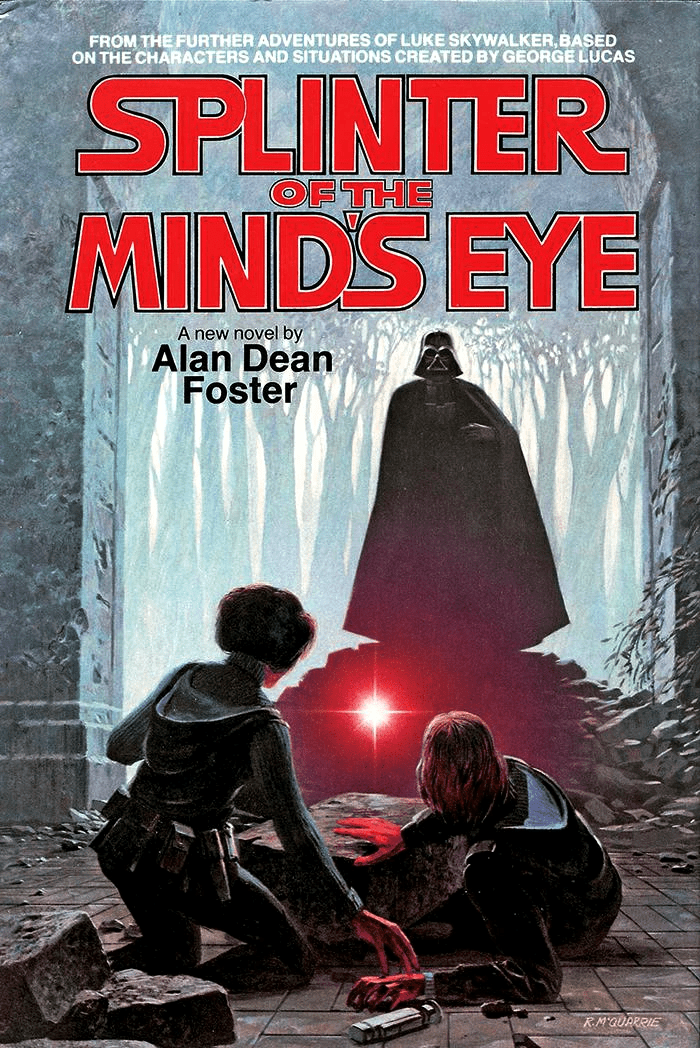
We’ll start with one of my favorite franchises, Star Wars. Back in 1977, the success of George Lucas’ space opera was far from certain. Still, Lucas gave the film a semi-open ending to leave room for more story. Yes, the Rebels had destroyed the Death Star. But Darth Vader, the Emperor, and the Empire were still out there, and Luke, Leia, Han, and the rest were ready for more adventures. So in case the film didn’t perform well enough to warrant an expensive sequel, Lucas commissioned author Alan Dean Foster to create a novel that would serve as an outline to continue the adventure. After consulting with Lucas, Foster wrote Splinter of the Mind’s Eye in February 1978.
Summary
After the destruction of the Death Star, the Rebellion is looking to get the upper hand on the Empire. On their way to recruit more planets to their cause, Luke and Leia, along with C-3PO and R2-D2, crash land on an Imperial-occupied swamp planet called Mimban and are caught up in a search for a mysterious artifact called the Kaiburr crystal. The crystal is said to be strong in the Force, which especially interests Luke. Unfortunately, their presence also attracts the attention of Darth Vader himself. The duo fight through Imperial prisons, the creature-infested swamps of Mimban, and a violent tribe of local Mimbans before finally making it to the temple where the crystal is housed. There both Leia and Luke face Darth Vader, narrowly escaping with their lives and the crystal.
My Thoughts
As a sequel to Star Wars, Splinter feels much more like an Indiana Jones story than a continuation of the sprawling space adventure the original movie set the ground work for. Space battles and family drama aside, the Star Wars movies aren’t really about treasure-hunting for the magical McGuffin.
As its own standalone novel, it’s not perfect. In fact, the first time I picked up the book, I got about 5 pages in before deciding to put it back down. From the beginning, Foster’s writing style is unnecessarily flowy and full of awkward phrases. It’s not everywhere, but there’s enough of it to be noticeable in places. The first paragraph itself is a good example:
“How beautiful was the universe, Luke thought. How beautifully flowing, glorious and aglow like the robe of a queen. Ice-black clean in its emptiness and solitude, so unlike the motley collage of spinning dust motes men called their worlds, where the human bacteria throve and multiplied and slaughtered one another. All so that one might say he stood a little higher than his fellows.”
I’m not saying that we need the terseness of stage directions to set the scene. But as the first paragraph about a space adventure through a swamp, it’s a little much.
I also think this proves without a doubt that Lucas didn’t plan every aspect of his story from the beginning, despite his comments to the contrary. For one thing, Luke is crushing very hard on Leia in this book, from the way he describes her:
“…whenever he looked at her, the other caused emotions to boil in him like soup too long on the fire, no matter if she was separated from him by near vacuum as at present or only by an arm’s length in the conference room… She could convince him of anything. Luke treasured those moments when she forgot her station and titles. He dreamed of a time when she might forget them forever.”
There’s also their plan to disguise themselves in the Imperial-occupied town, where their attempt to make themselves look more like the local miners inexplicably devolves into just mud wrestling. Or the scene where Luke just flat out tells an unconscious Leia that he loves her as Darth Vader is about to kill him in the story’s climax. So unless Alderaan truly is the equivalent of space Arkansas, Lucas probably (hopefully) had a different plan in mind for the two.
In addition to some weird descriptive writing and “Sweet Home Alderaan” playing in the background, there are aspects of the story that are unintentionally hilarious. For example, when Luke and Leia are trying and failing to blend in to the mining town where they’re stranded, they are approached by a gang of local ne’re-do-wells and told fighting in public is “against town decrees.” Then they immediately start fight with the two. Perhaps the funniest aspect, though, involves the Kaiburr crystal itself. Once the battle is won and they leave the planet with the crystal, the crystal starts to lose its potency in the Force. By the time they’re in space, the crystal is useless. All that effort and instead of a powerful Force artifact, Luke ends up with a paperweight.
There are some interesting side characters in the book. Luke and Leia are convinced to look for the mythical Kaiburr crystal by an old woman named Halla in exchange for helping them off-world. She acts as the Han Solo-type for the book, since Han himself isn’t present (apparently, Harrison Ford hadn’t agreed to do a sequel by the time the book was written). There are also Hin and Kee, two aliens imprisoned with Luke and Leia who help with the heavy lifting and creature fighting, Chewbacca-style. The books main antagonist, Captain-supervisor Grammel, is a typical Imperial officer: arrogant, haughty, and presumably British. After arresting Luke and Leia, it’s Grammel that passes on a shard of the Kaiburr crystal to Darth Vader and brings the planet to the Dark Lord’s attention. Finally, a group of Mimban natives called the Coway act as Luke and Leia’s backup army at the book’s climax, holding their own against the much more technologically-advanced Empire. I wouldn’t be surprised if Lucas at least thought about the Coway when creating the Ewoks for Return of the Jedi.
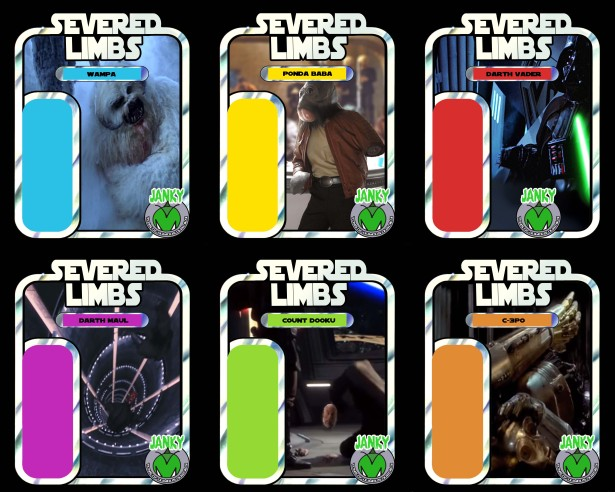
Darth Vader is also briefly in this book, mainly at the end. He’s pretty much the same as his character in the original film, and with hints of how he would appear in future films. Near the book’s climax, when Grammel’s attack on the Kaiburr crystal’s temple fails, Vader gets tired of his failures and abruptly kills him, ala The Empire Strikes Back. Vader also has a lightsaber duel with both heroes. He first duels Leia and beats her up pretty badly before knocking her unconscious. He then duels Luke to less success; Luke not only deflects his Force-based attacks, but also cuts off Vader’s lightsaber arm. Vader picks up his lightsaber to finish the job, but is too badly wounded from his de-arming and just falls backward into a nearby pit instead.
The also refer to him as “Lord Darth Vader” instead of just “Darth Vader,” further convincing me that Lucas originally intended “Darth” to be his spooky first name instead of an evil honorific (consider Obi-Wan’s line “[You’re] only a master of evil, Darth” before their fight on the Death Star). And considering Lucas’ defense of “Vader” is “Well it sound like the Dutch word for ‘father’” instead of just admitting he took it from the word “invader,” I feel justified coming to this conclusion. He did directly consult with Foster on the book, after all.
I’m skipping over a bunch of the book’s details here, like the scene where Luke has to defeat the strongest Coway warrior and then they’ll all listen to him, or the fights with various swamp monsters that seem to be everywhere on Mimban. And as much as I poke fun at it, the book isn’t all bad. For one thing, considering it was written during production of the original Star Wars, Splinter is the first piece of the old Star Wars Expanded Universe and therefore holds an important place in Star Wars history. And while I and millions of Star Wars fans should be glad the story was scrapped for the Empire Strikes Back that we got, I can’t help but think what might have been if Star Wars had continued with this story. What would we have gained? What would we be missing?
We’ll continue our series with the sequel to the 1994 film Stargate, Stargate: Rebellion.
 Culturally Opinionated
Pingback: Semi-Sequel Series – Culturally Opinionated