Why It Was Written
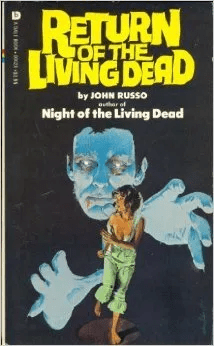
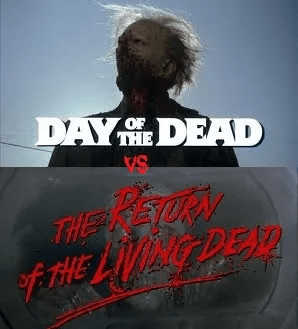
When George Romero and his writer John Russo parted ways after creating the genre-defining Night of the Living Dead, they split the fruits of their labor. Russo retained the rights to use the term “Living Dead” in any future projects, while Romero was free to create his own sequels to continue his story. In an extremely fortuitous coincidence, Russo penned a sequel novel to Night of the Living Dead called Return of the Living Dead and released it the same year that Romero’s sequel film, Dawn of the Dead, was released in theaters. Still even more luckily, some years later a film adaptation of Russo’s book (also called Return of the Living Dead) was released in theaters, again the same year as a Romero film (Day of the Dead). Sarcasm aside, the fact that the release dates of both Russo’s book and film happened to coincide with those of the much more successful films by his ex-partner makes the reasoning behind these decisions seem fairly obvious.
Summary
One horrifying night in 1968, the dead inexplicably rose up and walked the Earth in their hunger for living flesh before finally being brought under control. Ten years later, the dead begin to walk again and devour the living. In a rural American area, three sisters watch in horror as their father is eaten by zombies that invade their home. During the attack, they are saved by two state troopers and their deputies. The posse, with two bound prisoners in tow, take shelter against the horde in the sisters’ home. Unfortunately, the sisters’ relief is short-lived as their saviors soon reveal themselves to be looters impersonating officers to rob vulnerable rural families in the chaos. The oldest sister, Karen, who is very pregnant, goes into labor as the bandits flee with her sisters Ann and Sue Ellen. Luckily for Karen, the bound prisoners who are actual state troopers get free of their bonds and help deliver her baby before she dies from the effort.
The troopers chase after the sisters with baby in tow, and though one of the troopers doesn’t make it to safety, the surviving officer, Dave, finds shelter for the newborn in a neighbor’s house. Seeing the baby is temporarily safe, Dave goes after the bandits and their captives. He tracks them to a sprawling rural estate where the bandits are robbing the rich owners before murdering them. Dave manages to rescue the sisters and kill the imposters, promising to return with reinforcements to get Ann and Sue Ellen to safety. On his flight from the estate, however, Dave is mistaken for a zombie and killed by local law enforcement who are coming to aid any survivors. Both Ann and Sue Ellen are rescued and reunited with their nephew as the zombie invasion rages on around them.
My Thoughts
Seeing as Russo was the writer for the original Night of the Living Dead, it should come as no surprise that his sequel has a story very much like its predecessor. Much like Romero’s film, there is no one main character in Return, but rather a cast of characters. In fact, if the story didn’t directly reference the events of the first incident 10 years earlier, Return could almost be a standalone substitute for Night (albeit a slightly inferior one).
Similar to Night, I think one of the book’s strengths lies in the interactions of its characters. Both obviously focus on the ever-present danger of the reanimated and ravenous dead that the human characters must avoid and sometimes fight. But the zombies (or ghouls, as the movie and book call them) aren’t themselves necessarily evil. They’re more uncaring and animalistic than human. The real danger and conflicts come from other people taking advantage of a chaotic situation. The main conflict of Return is between the set of “innocent” characters (three sisters, a young man, and two captured state troopers) and another malevolent set (a gang of looters). The zombies are merely a backdrop and occasionally a means to off a character in a grisly fashion.
The horror of the breakdown of society is also a big theme of this story, similar to Night. The gang of looters, whose ultimate goal is to rob a rich estate, just happen upon one of the sisters out on a rural road close to her home, and take advantage of the situation to capture her family for their own nefarious uses. Two of the bandits named Carter and Wade abduct and imprison two state troopers and use their outfits to garner trust in their victims. Their accomplice, a degenerate called Flack, is able to let loose his true psychotic nature during the chaos. He delights in causing physical and emotional pain to others, and causes the deaths of several people by tying them up so they cannot escape being ripped apart alive by zombie hordes. Carter also unleashes his evil side in grisly fashion; rather than simply killing the two bound troopers, Carter instead shoots one man so that he will die slowly and painfully, reanimate as a zombie, and finish off his bound comrade.
Even well-meaning people fall victim to the lack of order caused by the zombie invasion. When the two actual state troopers escape their captors and search for safety at a nearby farm, one of the troopers is unceremoniously killed from the house by the family inside. After the situation calms down and the remaining trooper is invited inside, the family tells him their attitude was to shoot first and ask questions later for their own protection. The once-kindly and generous family has allowed fear and self-preservation to take away their altruistic notions during a turbulent time.
There are some differences between this story and the original film, of course. Firstly, the characters in this book have already lived through the events portrayed in the movie, so they already know to use headshots and fire to kill the undead. While Night takes place over the course of about 24 hours and is largely confined to a small claustrophobic house, Return takes place over a few days and in several locations throughout a rural area. Also, while the original film featured conflict between different strangers within the besieged house, the characters in the film would be considered scared and acting out of fear rather than evil or malicious. The villains in the book, on the other hand, are truly evil. And while both stories include a similar situation where a hero is seconds away from rescue but is accidentally killed by police, the details are different enough to warrant mentioning. While the character in film, Ben, is shot after being the sole survivor of a horrific ordeal, the hero of the book, Dave, is killed in a hail of police bullets while trying to get help for the two surviving sisters left barricaded in a large mansion. The tragedy is still similar in both instances.
No mention of this story is complete, however, without mentioning the baby. One of the aforementioned sisters, Karen, is very pregnant from the story’s beginning. Her gruff and frankly unlikable father is scandalized by her pregnancy, which is why when news of the zombie hordes arrives, Karen decides to run away from home. In her haste to leave she neglects to lock the front door of their house, which leads to her father being eaten by zombies as he sleeps. So a good idea all around.
Karen is picked up by the looters and brought back to the house, where she goes into labor during a zombie attack, and the two actual state troopers help her deliver the baby before she dies from the effort and stress. When the surviving trooper Dave makes it to a neighbor’s house and resolves to rescue the surviving sisters, he leaves the baby with the neighbors while he’s gone. They promise to take care of the baby, who due to a lack of food or a mother has not eaten since being born. At the story’s end, the remaining two sisters return to retrieve their nephew. While holding the baby, however, one of the sisters remarks that he “stared with its eyes so wide, so lusterless, so lacking the sparkle of new life.” It’s heavily implied that the baby actually did die at some point during the chaos and returned as a baby zombie. So despite the oversaturation of zombies in movies, TV, video games, etc., baby zombies continue to be a underutilized story element.
While I appreciated that the story retained much of what made Russo’s original story great, there were certainly aspects that I didn’t care for. The introduction, for example, doesn’t retell the events of the first story or give insight into the reasons behind the reanimation. Instead, Russo writes a (thankfully) short opening waxing on the nature of death, how the dead are the only ones who don’t need to fear death, how life can be so important while it’s being lived and then so trivial when it’s over, and the like. I almost put the book down there, afraid that there was going to be more of this philosophizing throughout. Luckily, this was the only instance of it.
Also, while the story itself was fine for me, Russo’s writing style at times was a little jarring. For example, when the main cast of characters splits up, the story first follows group A as they attempt to escape the zombie horde in two cars. One character, Billy, is killed in the process when he’s pushed out of a moving truck and eaten by zombies, and we are shown the incident in detail. When the next chapter picks up with group B back at the house, the troopers are trying to assist Karen in giving birth. But in the description of their planning while worrying about an impending attack we are told:
“Dave did not know that some of the creatures had temporarily satisfied themselves on the flesh of the boy, Billy, who had been tossed from the bed of the truck to appease the ghouls while Carter’s gang made good their escape.”
It’s fine to refer back to an incident we the audience know about in order to show showcase Dave’s lack of knowledge. But this is a strange way of wording the sentence. It’s almost as if Russo wrote the chapter with Billy’s death, put that chapter in his desk drawer and went to bed, and then woke up the next morning and wrote this next chapter without the previous pages in front of him. We know what happened because we read it literally two pages ago. There are one or two more instances like this. My best guess is that this comes out of Russo’s experience as a screenwriter and that he had trouble translating some of those skills to telling a story as a novelist.
All in all, I felt this version of Return of the Living Dead was a good sequel consistent with both the story and the themes of the original. And though Romero’s own sequels are the canonical continuation of the story, this book is a worthy alternative. Even if it was probably just written as a cash grab off the back of the more successful Romero zombie series.
It’s worth mentioning here that there is a also a movie called Return of the Living Dead from 1985, and that it was loosely inspired by Russo’s book. Know that when I say “loosely inspired by” that I mean the only similarity they share is their name and the inclusion of zombies. The film is totally different than the book. Whereas the book still manages to retain some of the claustrophobic, Twilight Zone-esque social commentary that has helped the original last as a classic, the film is a shlocky, horror comedy B-movie that mainly attempts to cash in on the Romero’s success. To be fair, the movie is loved by its fans and did well at the box office upon release. It adds to modern zombie lore in that it is the first piece of zombie media where zombies specifically go after human brains instead of the whole human.
It’s honestly not a terrible movie, it’s just a prime example of the 80s-B-movie charm that I find a bit of an acquired taste. Maybe it’s because I’m a 90s kid, so what do I know? Roger Ebert like it. Then again, he didn’t like Alien or John Carpenter’s The Thing, so what does HE know? I’ll let you decide for yourself.
All in all, I’d recommend the film if you’re looking for a dumb scary movie around Halloween, and the book if you’re into the early days of zombie media.
We’ll shift to a lighter tone with our next entry, the sequel to beloved children’s classic E.T., E.T.: The Book of the Green Planet.
 Culturally Opinionated
Pingback: Semi-Sequel Series: “Stargate” and “Stargate: Rebellion” – Culturally Opinionated