Why It Was Written
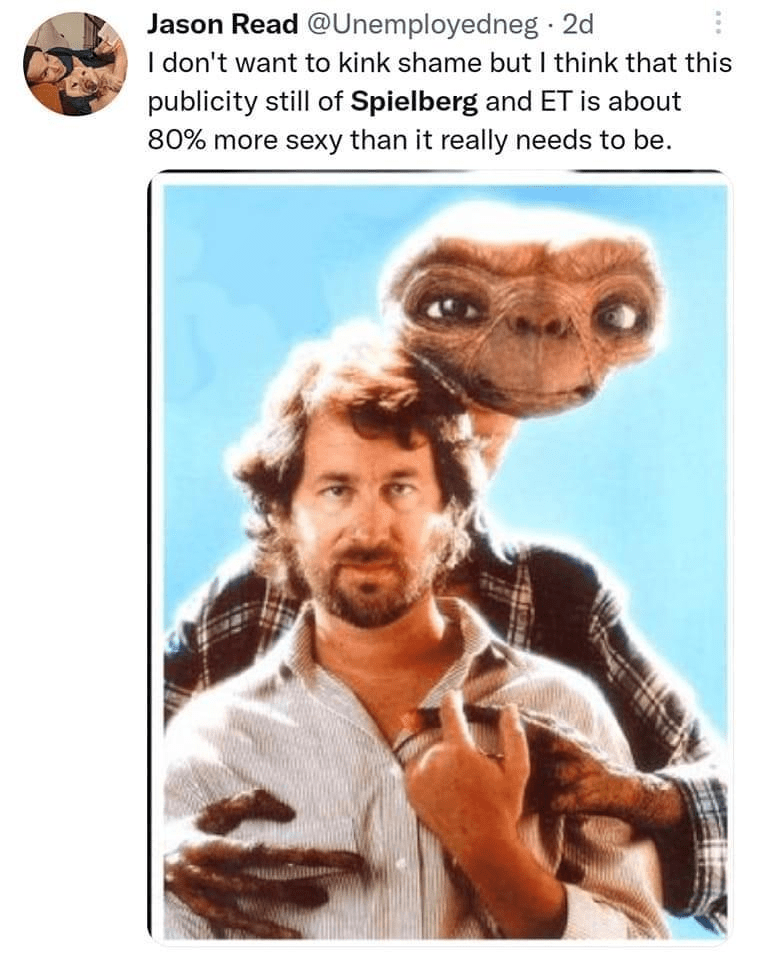
E.T.: The Extra-Terrestrial is considered by many to be one of the most beloved children’s films of all time. The story of young boy Elliott, the titular alien E.T., and the bond they develop during their short time together won over audiences and critics alike upon its release in 1982. It shattered the box office record set by Star Wars as the highest-grossing film of all time and launched the film career of Drew Barrymore. It raised the Hershey Company’s profits by 65% because E.T. ate Reese’s Pieces, and cemented E.T. as a cultural icon. It inspired what is still held as the worst video game of all time. Most importantly, E.T. is praised for normalizing science fiction for all audiences, not just Star Trek devotees or fans of schlocky, drive-in monster movies.
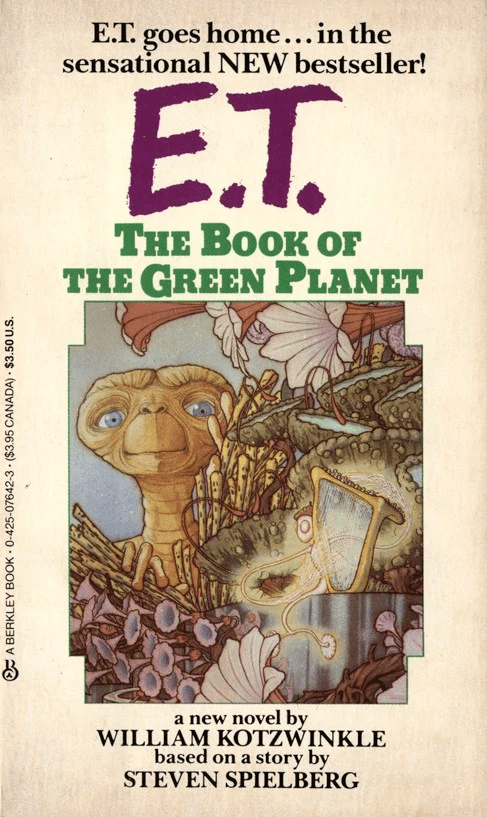
In short, E.T. was a very important film. So important that the author of the film’s novelization, William Kotzwinkle, felt that it deserved a sequel, which is how we got 1985’s E.T.: The Book of the Green Planet.
Summary
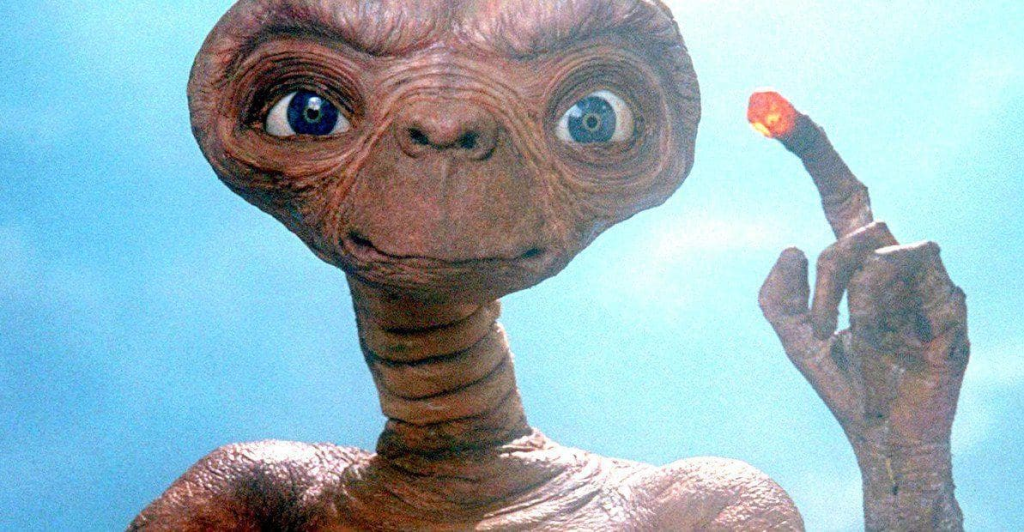
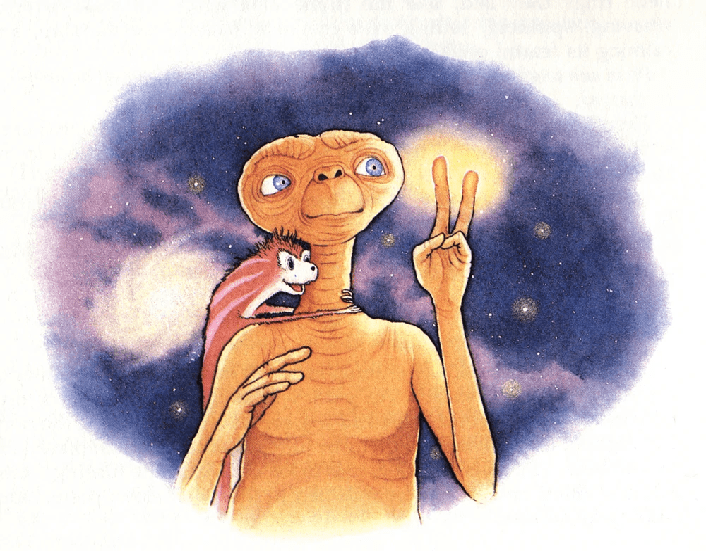
The book opens immediately after the events of E.T. as E.T.’s spaceship blasts off after saving E.T. from the California police. As the ship travels through space and time to his home, the Green Planet, E.T. is already very sad about leaving his Earth friends behind, particularly Elliott. It soon becomes clear that E.T. is in big trouble back home for getting left behind on Earth, and upon reaching his home planet E.T. is returned to his rural home instead of joining his botanist colleagues in the capital cities. Outcast and humiliated, E.T. tries to return to life on his planet tending plants under his teacher Botanicus. However, his thoughts continuously return to Elliott. E.T. constantly uses his advanced telepathic powers to see what Elliott and his family are doing on Earth. To his shock, he realizes that Elliott is growing up, which he thinks is the worst possible tragedy to happen to anyone. He resolves to return to Earth, which is forbidden. With the help of his friends, he secretly builds a rocket out of a giant turnip and escapes the pursuing authorities of the Green Planet. The book ends with E.T. and his friends on their way to Earth. E.T. gains another glowing fingertip, signifying “a great deed well accomplished.”
My Thoughts
This year happened to be the 40th anniversary of E.T.‘s release, and to celebrate some theaters were showing the movie on the big screen. I didn’t learn this until after I had finished The Book of the Green Planet, but seeing as I hadn’t seen the original film in probably 15 years or so, I thought it’d be a fun way to add something to the experience of reading the sequel.
And after seeing E.T., I came to two conclusions. First, that I can definitely see why audiences 40 years ago became so enthralled with the movie after its release. And second, because I enjoyed it so much and thought its ending was so good, I’ve decided that I’m not a fan of The Book of the Green Planet. That might seem obvious: that a 31-year-old man wouldn’t be a fan of a children’s book written before he was born. But let me explain.
From the moment the book opens, E.T. is melancholy and sad. At the outset, this makes total sense. The movie’s final scene where E.T. and Elliott say goodbye is heart wrenching, and E.T. obviously misses his new friends on Earth. But even after finally reaching his home planet, returning to his mentor and his parent, and starting to settle down into his old life, E.T. does almost nothing but mope about how much he misses Elliott and Earth. He constantly sends little telepathic messages back across the galaxy to Elliott, which physically manifest themselves as electrical impulses or little E.T. clones. At one point, for example, E.T.’s message goes into the arcade game Elliott is playing, spelling out the letter “E T” on the screen. Another time, an E.T. clone physically lands in a pool where Elliott is swimming, trying to get the boy’s attention. Each time E.T. tries to communicate, however, Elliott gets distracted by something else and misses the message: the arcade machine gets unplugged before Elliott sees anything, and while Elliott attempts to impress a girl at the pool the E.T. clone gets swept down the drain. In fact, the only time Elliott is aware that E.T. is attempting to reach him is when E.T.’s psychic message takes the form of a floating light and warns him when his girlfriend’s parents are coming home early.
Meanwhile, on the Green Planet, E.T. is doing everything he can to find a way back to Earth. Since this is forbidden given the trouble he caused by being left behind, E.T. must find sneaky ways to accomplish this. He first recruits several unsavory creatures from the planet’s depths to help him steal and then pilot a starship. E.T. uses his knowledge of plants to create a drink that drugs the ship’s crew, but the automated systems catch him and his accomplices. After this first failed attempt, E.T. hatches a new plan. He secretly grows a giant turnip and uses stolen parts from starship factories to create a living spaceship. He finally makes his escape from the planet’s authorities into space with several companions.
This being a children’s book, the idea that E.T. would be doing something he isn’t supposed to do is inconceivable to most of the various creatures who help him. He has to essentially trick them into completing tasks independent from each other in order to keep from arousing suspicion. When E.T. is growing the turnip-ship, for example, he hides his project from the prying eyes of the planet’s government by convincing a forest of Jumpums, sentient trees who love to jump more than anything, to play their jumping games around his ship. The trees get to enjoy their game, and E.T.’s secret remains. E.T. also feels like he has been outcast by his society upon his return home, and that he doesn’t belong to his old life anymore. His inner circle of accomplices is made up of other outcasts who share E.T.’s sense of not belonging: a mischievous, trouble-making weasel-like Flopglopple, an obsolete robot (annoyingly just called “the robot”), and Micron, a member of the engineering-oriented Micro Tech species who once visited a planet where he heard music that was so beautiful that it changed him, causing him to pursue music instead of engineering, which made him an outcast.
He also initially seeks the help of several unsavory creatures deep underground ominously named Sinistro, Electrum, and Occulta, who agree to help E.T. in exchange for Earthly treasures like bicycles, football helmets, and TVs.
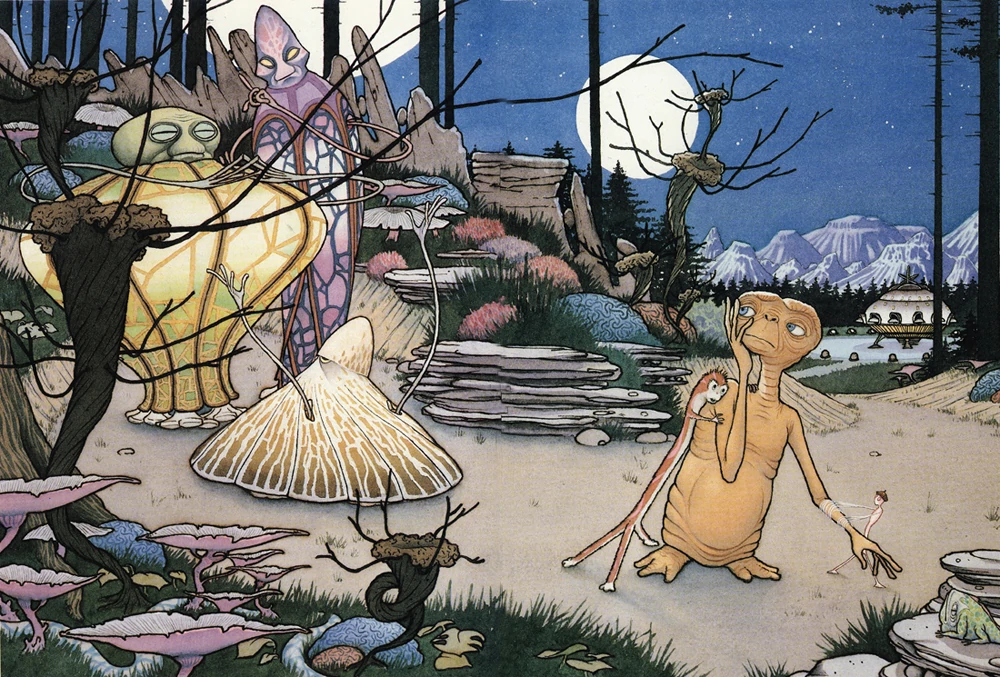
The recruitment of these beings especially highlights E.T.’s desperation. The three subterranean dwellers are made of crystal and metal, while the current culture of the Green Planet is focused on floral and living technology and creatures. E.T. notes the danger of such an alliance upon meeting them for the first time.
“E.T. saw that [Occulta’s] eyes reflected dreams, of the former eon, when metallic beings had ruled, and gathered the metals of the moons and the diamonds of the comets, and ravaged the planetary system with war.”
All of this is to say that this sequel paints E.T. as having been changed by his experiences on Earth, and not necessarily for the better. E.T.’s greatest concern is that Elliott will become a man and forget about him, as he senses when his telepathic signals show Elliott worried about girls and growing up. But while E.T. is worried about Elliott maturing out of remembering E.T., the alien himself has basically matured out of belonging to the culture of his home planet. The creatures and lifestyle we see on the Green Planet belong very much in a children’s book. Everything has a silly name (Flopglopple, Jumplums, Magdol the Sulking Beauty and Shemoda Nuncoor the Sleeping Princess Plant, etc.) and spend their days having fun in their Edenic home. But E.T. takes advantage of this frivolity for his own means. He doesn’t want to hurt anyone, but he also doesn’t tell them the entire truth for asking for their help either. E.T. has grown up, in a sense, and it has changed him just as it is changing Elliott. After a certain point, you can’t ever really go back.
And that’s not something I really want to think about, having just rewatched the original film. At the film’s end, E.T. famously tells Elliott “I’ll be right here” and he taps the boy’s forehead. E.T. and Elliott may have had to part, but they’ll always remember each other as they live the rest of their lives. But the implication is that both boy and alien will actually live their lives, not be mentally stuck in one moment of time. One of the film’s themes, then, seems to be about dealing with loss. Loss is a hard but inevitable part of growing up. Eventually you have to let it happen and grow from the experience. The alternative is getting stuck in memory and being miserable, trying to experience something that can’t be experienced again. If this is one of the themes of the film, then E.T. fails to learn it through the course of the book.
In short, E.T.: The Book of the Green Planet is a sad book that made me sad, and it’s even sadder taken in conjunction with the film.
Less Serious Thoughts
But besides making me feel sad, The Book of the Green Planet featured other aspects that I thought were interesting.
As stated above, this is definitely a book written with children in mind. The silly names of the creatures and interactions put one in mind of other children’s works such as The Wizard of Oz. There’s a lot of what I would consider not “world-building” so much as “world-introducing,” another aspect of young children’s literature. We are told some aspect of the Green Planet exists (plants can talk, for example, or there are giant lizards in the forest who don’t like to be bothered) but not necessarily why they exist outside of “they just do.” It’s more “look at this weird thing but don’t think too much about it.”
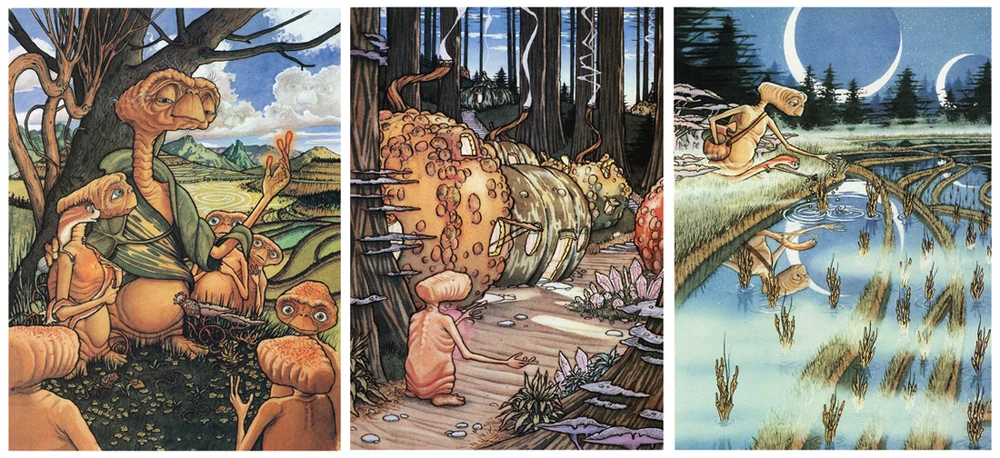
I also think it’s strange that E.T.’s name on his home planet is “E.T.” In the film, Elliott is the one who gives his new friend the name after learning of his alien origins, the letters E.T. of course standing for “Extra-Terrestrial.” They also happen to be the first and last letters of Elliott, which is significant given the psychic bond between the two. But in this book, when E.T. finally makes is back to his home village, everybody calls him E.T. as if that has been his name the entire time – his friend the Flopglopple, his mentor Botanicus, even his parent (who, for the record, seems to be named “Parent” based on E.T.’s interaction with him/her/it). I get that it might be difficult to reconcile E.T. having his own name like “Zenzak” or “Gloopie” or something when he’s cemented himself in pop culture as “E.T.” Still, it’s a weird choice to name your child “Extra-Terrestrial” when your planet is billions of light years away and in another dimension from Earth.
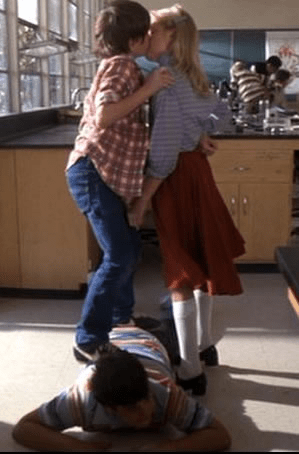
Also, if E.T.’s biggest fear is that Elliott will grow up and forget about him, how does giving Elliott the courage to kiss Julie the pretty girl at the school dance keep him from growing up? I’m pretty sure that’s a fairly universal rite of passage to adulthood in most John Hughes movies. Although it’s good that she at least gets a name in the sequel, considering the role in the movie was just “Pretty Girl.”
I do like how E.T., fresh off his time on Earth, tries to incorporate Earth slang into his speech, confusing his friends and the government of the Green Planet. He tells people about being “in the house of the Dog” and sharing a magnificent closet with a creature called “Baa Sket Ba, who is a little round being filled with air.” He promises the underground beings treasures of Earth if they help him, and they brag about becoming Burger Kings with great closets of their own. And even though it’s apparently meant to be inferred by the original movie, I had no idea that E.T. is apparently a Doctor of Botany, First Class on his home planet. The film opens with the aliens collecting plants on Earth, sure, and their spaceship is full of mushrooms and alien plant life. Still, the book presents his title like it’s common knowledge that I must have been too busy crying at the film’s ending to catch.
Finally, I have one very specific bone to pick with the greater E.T. lore. During the film, we are shown that one of E.T.’s powers is bringing dead plants back to life when E.T. makes some dead flowers bloom. The same houseplant wilts when E.T. is dying, and later springs back to life again when E.T.’s health returns. At the end of the film, Elliott’s sister Gertie gives E.T. the plant to remember her by, and he takes it with him on his ship. When the book opens immediately after this touching scene, E.T. mentions the plant as being special as he begins his decent into melancholy.
My issue is this. Here is a picture of the plant in the movie.
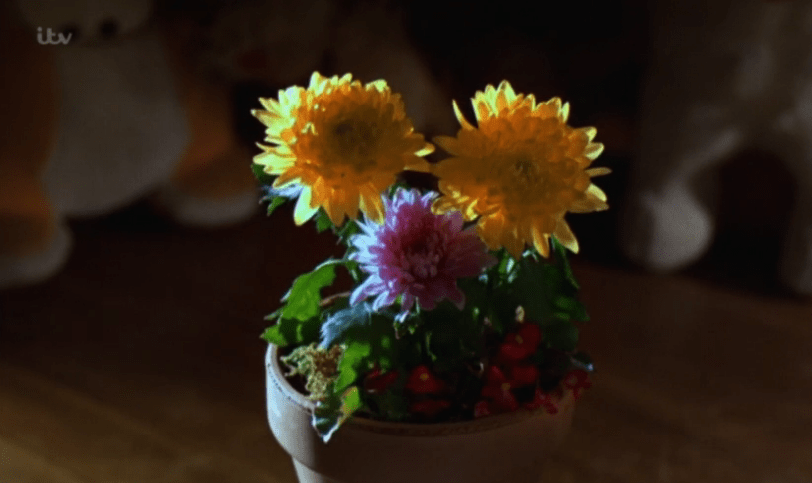
And here is a chrysanthemum.

The plant in the film is clearly a chrysanthemum, with two yellow flowers and one purple one. In the film’s summary on the E.T. Wikipedia page, the flower is referred to as a chrysanthemum. And yet The Book of the Green Planet continuously refers to them as geraniums. They are called “Gertie’s Geraniums,” which is admittedly more alliterative. Normally I could chalk this up to the book simply taking a liberty of its own or even forgetting what flower was in the film. But multiple other sources I found also referred to the flowers as geraniums. For reference, here is a picture of a geranium.

Compare that to the screenshot above and it is clearly not the same kind of flower. Yet most disturbingly of all it this section from the original script for E.T. The species of flower is only mentioned once in the entire screenplay, and they are referred to as… geraniums.
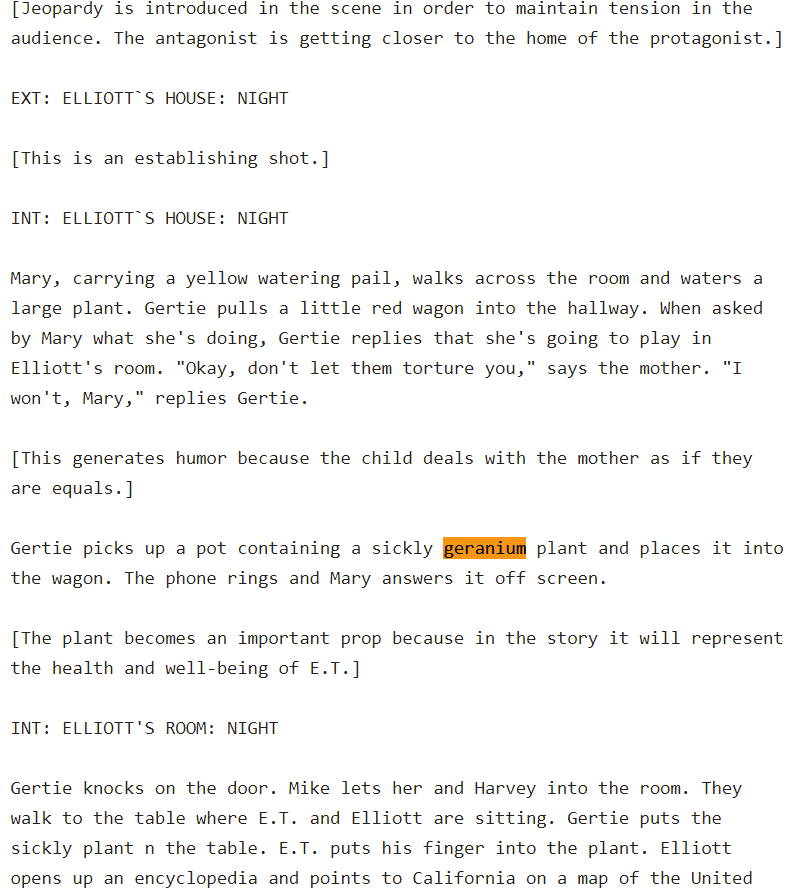
To be fair, geraniums make more thematic sense: In the realm of flower symbolism, geraniums symbolize “happiness, good health, good wishes and friendship,” while chrysanthemums symbolizing “longevity, fidelity, joy, and optimism” and yellow chrysanthemums specifically symbolizing “neglected love or sorrow.” Considering that the flowers in the movie are meant to represent E.T.’s failing health and then recovery, the former is much more appropriate. My guess is that the prop department saw the script called for flowers, grabbed the closest pot from the plant closet, and just called it a day without checking what kind of plant it was.

With this in mind, it makes sense that William Kotzwinkle, after writing the novelization of the movie, would include geraniums in his sequel. Still, the dissonance disturbs me.
Other Sequels
It’s also worth noting that this book isn’t the only sequel to the original film. The first proposed sequel came from the mind of the film’s director himself. Stephen Spielberg and E.T.‘s writer Melissa Mathison wrote a treatment for a sequel concerningly titled Nocturnal Fears. In this horror sequel, Elliott and his friends would be captured by evil aliens and wait for E.T. to rescue them. Eventually, though, Spielberg decided that this was not a great idea for an E.T. sequel, feeling it “would do nothing but rob the original of its virginity.” I can’t imagine why it took him more than two minutes to come to that conclusion.
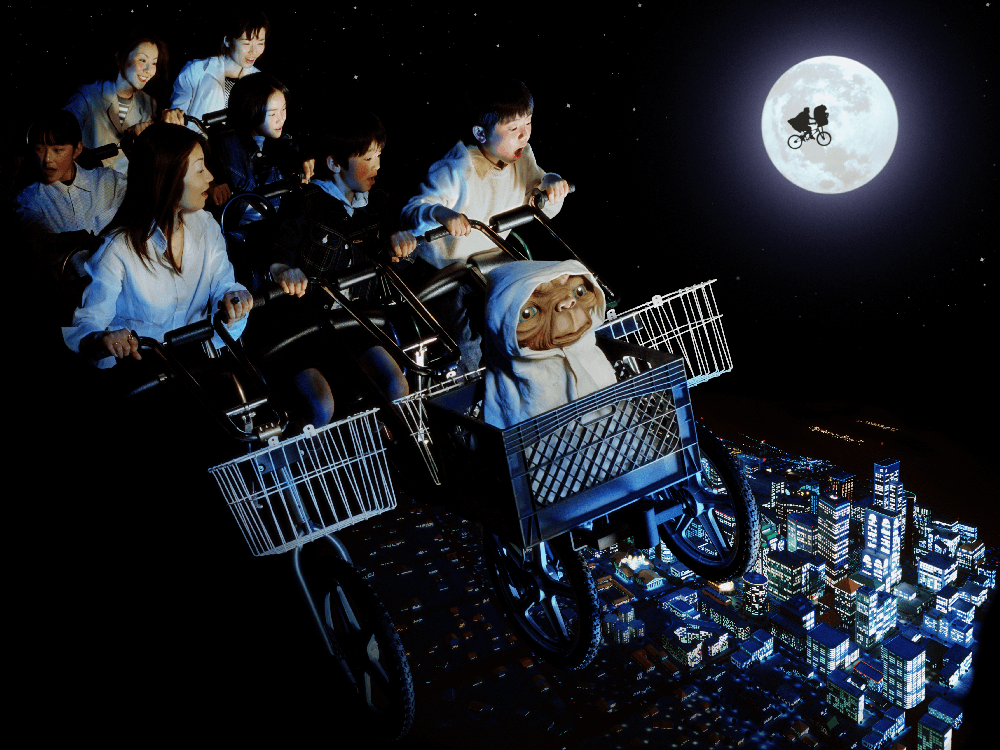
Those who have visited the Universal Studios theme park in Florida might also remember that there is an E.T.-themed ride called “E.T. Adventure.” In it, riders travel with E.T. to his home The Green Planet, which is in danger. As Stephen Spielberg himself states in the pre-show video, “Only E.T.’s magic healing touch can save his friends and bring his planet back to health.” Riders then mount flying bicycles and travel to The Green Planet, getting E.T. home and saving the day. Besides the setting of The Green Planet, the ride features other similarities with the book, including E.T.’s mentor Botanicus and a wide array of colorful plant creatures who are E.T.’s friends. While not a sequel per-se, the ride expands the story of the film in an interactive way for visitors, not least because the E.T. animatronic thanks riders by name at the ride’s conclusion.
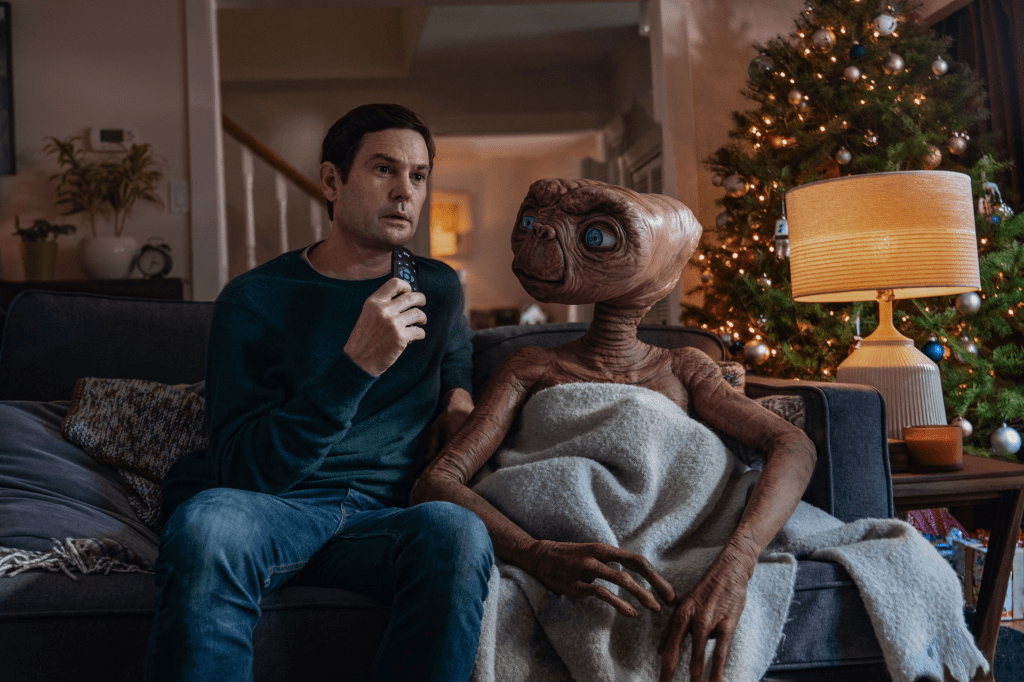
Finally, NBC and Xfinity released a 4-minute long commercial in 2019 called “E.T. and Me: A Holiday Reunion.” In this short “sequel,” E.T. visits a grown Elliott and his family to spend Christmas Eve and Day together. Elliott’s children, Elliott Jr. and Maggie, have fun playing with their new friend and even get to ride their bikes over the moon like their father did at their age. Eventually, E.T. returns home (though this time not before he leaves a sort of alien telephone with the family) and the commercial reminds us about the importance of spending time with family (preferably while watching content for the low price of $19.99 per month). I appreciate that the commercial features actor Henry Thomas reprising his role as Elliott and the same iconic John Williams score. Still, the corporate tie-ins and outro diminish some of the earnestness of the “sequel” for me (it is a commercial for Xfinity, after all), and considering E.T. isn’t currently available to stream outside Amazon Prime or Apple TV it seems a strange choice for an advertising campaign.
So if you’ve cried yourself dry by the end of E.T. and just have to keep the magic alive, you could do worse than The Book of the Green Planet. Of course, you could ride the Universal ride and have E.T. thank you personally, too, but the book is a close second.
Next time we’ll be looking at the sequel to another project directed by Stephen Spielberg: the sequel to Jurassic Park, Michael Crichton’s The Lost World.
 Culturally Opinionated
Pingback: Semi-Sequel Series: “Night of the Living Dead” and “Return of the Living Dead” – Culturally Opinionated