
Animation has always been a big part of my life, from the cartoons I spent hours consuming on TV to the animated films I re-watched over and over again growing up. Even though 3D animation has largely replaced the 2D cartoons of my childhood, animated shows and movies are doing better than ever financially as well as culturally. And while I can usually find some new project that interests me, I still enjoy revisiting the animated works that I grew up with. And one of my favorite aspects of these older films and shows is their music.
While there are lots of these animated works I enjoy for their compelling stories, beautiful and unique art styles, or just for plain old nostalgia, a consistent reason for watching these films of my childhood is their music. There are so many lines of dialogue or even entire scenes that I remember well because I associated them with the music that accompanies them. And that’s to say nothing of the songs performed in the movies themselves. Though Disney is certainly a giant in the category of “memorable songs from animated films,” over the years many other studios have made worthy contributions to the catalogue of animated movie songs worth listening to. Entire music playlists have been dedicated to these songs and more, giving fans like me something to enjoy revisiting.
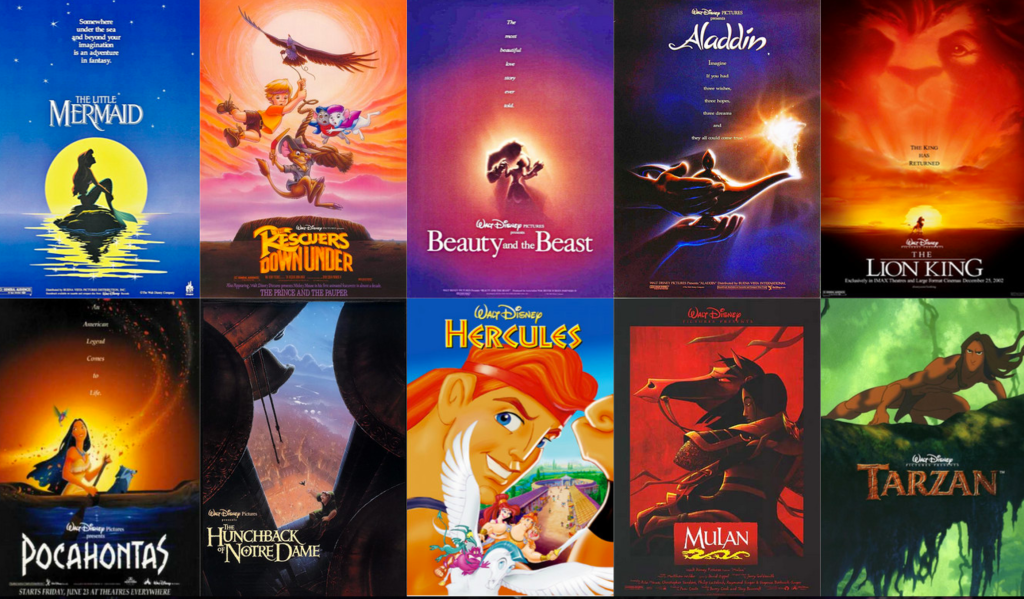
During one of these music binges, while listening to everything ranging from Beauty and the Beast to Tarzan to Encanto, a thought occurred to me. It seemed that a large number of these movies shared a trend. During the end credits of the film, many of these movies would play one of the movie’s songs, only as an R&B version instead of the Broadway-style ballad featured in the film. These alternate versions of the songs were frequently as good as the ballad versions, but I thought it was interesting that they were so often chosen to be R&B-style arrangements. And what’s more, these songs seemed to be most prevalent in movies from the 1990s and early 2000s than in later years.
It seemed to be just a coincidence, but the more I thought about it the more I wondered what the reasoning behind this observation was. I even wondered if this really was the case, or if I was allowing my nostalgia to inflate a few instances into a large but fictional trend. I was intrigued.
So I set out to formally discover whether or not I was right, that animated films tended to play R&B covers of songs over their credits. And if I was right, I wanted to know why R&B specifically. What made that genre more desirable for this than, say, rock or pop? Over the next few weeks, I did a fair amount of research and finally answered these questions.
But before we begin, I want to quickly highlight an article by author Paul Astell on his blog Feeling Animated called “Top 50 Credits Songs from Animated Films.” Astell gives interesting details about many great songs from animated films, and made doing some of the research for this a lot easier. If you find my article interesting, I would encourage you to check out his as well.
Data Acquisition
To answer my questions, I first needed to know how many animated movies actually feature songs specifically written for the film that played in some form over the end credits of the film. Next, I had to map out the frequency of songs by decade, as well as the breakdown of genre across this 40-year timespan. And finally, I wanted to correlate my data with information about general trends of music genres this time period. Only then would I have my answer.
One other important note is that I’ll only be focusing on American (and a few British) animated films. If I were to widen the scope of my question to the entire world, it would never end. The inclusion of anime alone, which generally features both an opening and ending song that changes twice in one season, would take me a year to compile.
Movies/ Songs
First up was to catalogue movies that qualified. Rather than relying solely on my memory, I scoured Wikipedia pages for “List of Animated Films by Year” and then the individual pages themselves, as well as many YouTube videos of various film’s end credits, searching for films with end credits songs. Some factors made my search a little easier: films in general didn’t start to have end credits (as opposed to beginning credits) until the 1970s. Moreover, I was only looking at animated films, and only those with actual songs over their credits instead of simple orchestration. In the end, I found that there are about 121 films that fit my categories, beginning with 1982’s The Last Unicorn and ending with 2021’s Encanto.
Interestingly, of these 121, Disney films only accounted for about 35. Considering how well-known Disney films are for this practice, I think it really says something about the quality and staying power of their films.
This was one of the most fun and interesting parts of the entire endeavor for me. For one thing, I was able to revisit some of my favorite songs from childhood, including but definitely not limited to Disney classics. What was interesting, however, was discovering songs I hadn’t heard before in movies I wouldn’t have thought fit my categories. For example, the 1993 fan-favorite film Batman: Mask of the Phantasm ends with a jazz ballad “I Never Even Told You” that perfectly frames the 1930s battle of wits between Batman and the titular Phantasm. I also discovered there were songs in movies I had seen numerous times (The Emperor’s New Groove, The Road to El Dorado, and Atlantis: The Lost Empire, to name a few) that I didn’t know about because I had apparently never felt the need to watch their credits. In doing so, I missed out on some good songs. There were lots of earworms that settled in my brain the week I did this part of the research.
Decades/ Genres
Next came separating the films into their respective decades as well as separating the film’s songs into their genres. Having grown up during the 1990s, I figured that there was a bit of a bias in my recollection. It probably wasn’t that the best animated movies of all time happened to come out during my childhood and everything that came out afterward was inferior. I just had no frame of reference during that decade, and subsequent films were more heavily scrutinized by a more nuanced, mature George. It also probably wasn’t true that there was an inordinate number of animated movies released during the 1990s; it was just that the overwhelming majority of movies I was exposed to were animated. I was willing to acknowledge my shortcomings.
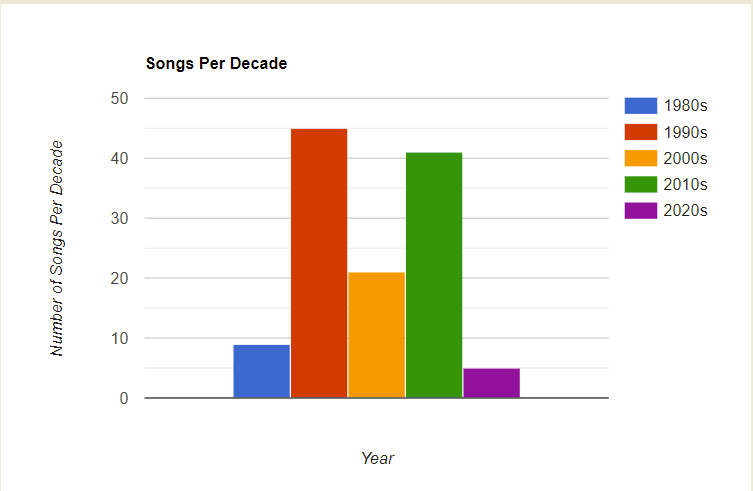
As it turns out, however, there is some truth to my recollections. For instance, the 1990s actually was the decade with the majority of animated films with end credits songs. Interestingly, in close second place are the 2010s, indicating a decade-long dip in the trend’s popularity. Also, ratio of films to songs per decade peaked with the 1990s as well. Every decade but the 1990s featured a 1:1 ratio of songs to movies, i.e. one song per film, with the exception of The Angry Birds Movie 2 in 2019 which had 2 songs. The 1990s, however, featured 45 total songs to 37 movies, meaning 8 movies feature two separate songs written for their films in the end credits. If nothing else, this indicates the 1990s was the decade when studios felt most confidence in this trend.
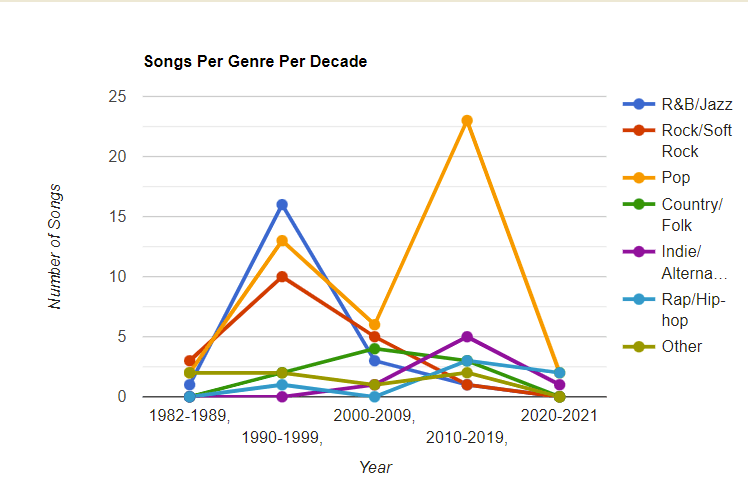
Equally important was tracking the frequency of genres represented in these movies’ songs. Remember, my initial thought was that movies of the 1990s seemed to all be full of R&B songs or covers of songs. The data seems to support this, as laid out by the chart above. The R&B and jazz genres were represented more in the 1990s than in movies from any other decade. We’ll look at that more closely in a bit. What was surprising to me was the popularity of other music genres at different times. For example, end credits songs have been overwhelmingly represented by pop music for the last decade, accounting for over half of the songs accounted for during that decade. There is also the rise of indie and alternative songs being featured in films during the 2000s and into the 2010s. It’s also interesting to compare the prevalence of pop during the 2010s to the spread of the 1990s and 2000s. The data points for these decades are much closer together, indicating a wider range of musical styles and less homogenization of what studio heads and marketing executives think people like.
To be fair, there are some limitations to these graphs and the data they represent. For one thing, while separating these songs by decade seems ideal for a 40-year timeframe, the beginning and endpoint of the data isn’t properly represented compared to the rest of the graph. There were only 9 songs for the entire 1980s because the trend was just beginning during this decade; similarly, there were only 5 songs in the 2020s, of which we’re only in the third year. However, while this skews the graphs slightly, I still believe the data speaks for itself and is nevertheless a good representation. We might even make hypothetical assumptions based on the data given. Imagine if the “end credits songs” trend had begun a decade earlier in the late 1970s, and how many rock anthems and ballads we could add to our Spotify playlists from our favorite animated films.
Genres in General
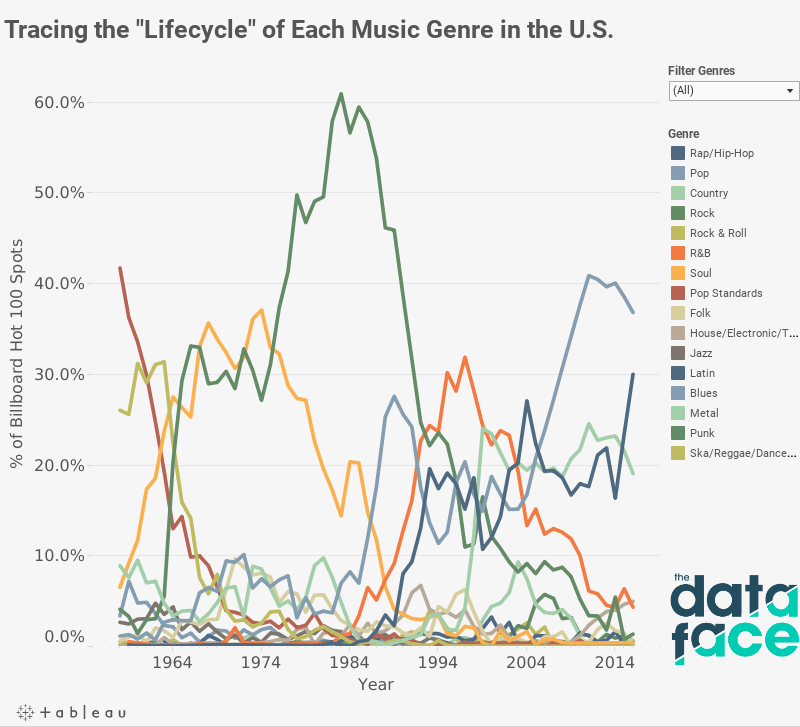
Finally, I wanted to see if the trends present in my data correlated to music trends in general. Although movies generally reflect trends of their times, especially when it comes to cultural aspects like clothing or music, I thought there might be a possibility that these songs could be somewhat removed from the wider trends of their release decades. However, the data would indicate otherwise. There is essentially a direct correlation between the amount of songs in a particular genre and the popularity of that genre in the wider world. So many of the 1990s movies featured R&B-style songs because R&B was king at the time. In the 2000s and 2010s, pop music rocketed to popularity, and so the majority of end credit songs followed suit. We can also see hip-hop and rap becoming more popular in this time, a trend reflected in my research. And while this particular graph only goes up to 2014, we can assume that the trends present in my own research are probably at least mostly reflected in popular music trends as a whole.
Bringing It All Together
So, now that we have the data, what does it all mean?
In short, I think it means that my initial assumption is mostly correct: that during my formative years of the 1990s, animated movies experienced a boom. These films also started the trend of playing songs over their end credits instead of instrumental music. And of these songs, the majority were R&B-style covers or originals.
But we can go even further looking at the trend of end credits songs as a whole. Though Disney certainly popularized the practice by incorporating end credits songs into their 1990s films, they didn’t start the trend. Animators of the 1980s such as the legendary Don Bluth pioneered the practice to enhance their projects, perhaps in part to set them apart from the animation giant Disney. Once Disney picked up the trend, however, everyone else seems to have wanted to copy them.
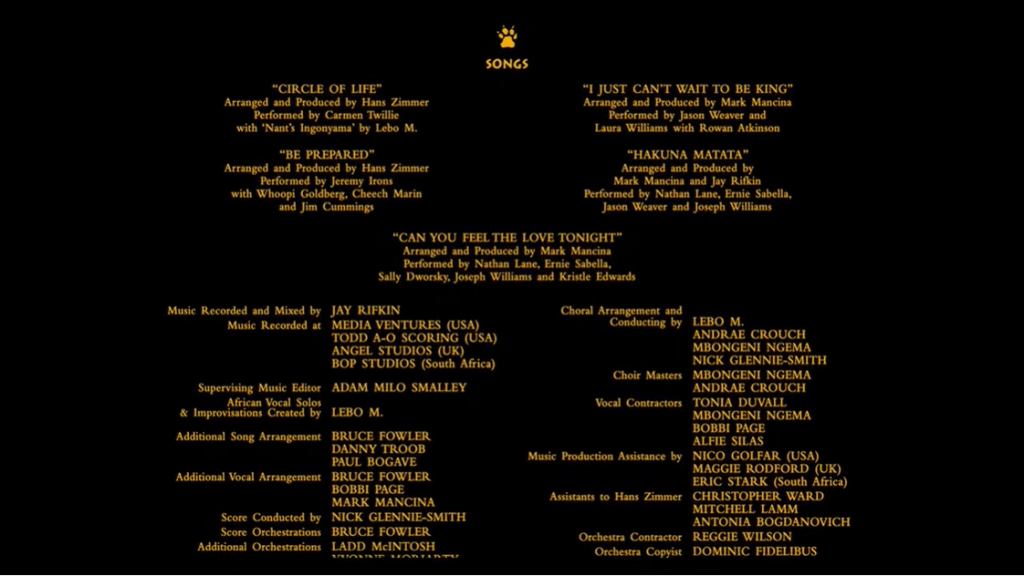
I also think the genre of R&B specifically fit well with the types of songs that tended to be covered in the 1990s film’s end credits. Beginning with The Little Mermaid in 1989, most of the Disney films of this time were full of Broadway-style songs, including catchy and timeless love solos or duets. These include classics like “Beauty and the Beast,” “Can You Feel the Love Tonight?” and “A Whole New World,” among many others. The “movie versions” of these songs were already slow, intimate, and musically complex as well as showcasing the talents of their performers. As modifiers, these are qualities that also describe R&B. It makes perfect sense, then, that a heartfelt song about eternal love or yearning of love would be perfect for an R&B cover. Not only does the cover get to feature artists not present as voice actors in the film, but it also creates a standalone version of the song separate from the specific context of the film’s story (and therefore a more easily marketable single). As to the simultaneous emergence of these ballads in their Broadway-style movies and that of R&B in general, I will leave it to others to determine whether this was an intentional decision by trend-setters of the decade or simply a happy coincidence Disney took advantage of.
As more and more studios decided to delve into animation, different kinds of stories began to warrant different kinds of songs over their end credits. To continue the analysis Disney films, later films like Frozen and Moana feature themes more of discovery of one’s self and the inner struggle rather than external love stories; their featured songs reflect this theming. Films from other studios take completely different approaches in their films’ themes and songs as well. Many contemporary films, while perhaps featuring some sort of love story between its protagonists, tend to focus more on the importance of family and maintaining healthy, honest relationships with all people in one’s life, not just potential romantic interests. As a result, there are many songs that are much more upbeat and energetic. The dominance of pop music we saw before also plays into this change. While the genre of pop can certainly impart plenty of emotion and meaning, its themes tend to focus more on the joys and frustrations of relationships or personal feelings of happiness than on the yearning and romantic depth of R&B.
One important factor to remember is the genre of films we’re studying, i.e. animated children’s films. I am a firm believer that animation is not solely for children, and luckily that is the general consensus of people my age and younger. But overall, these films, especially the older ones, were made with children as their target audience, and so have to be analyzed accordingly. With this in mind, the idea of adding songs to any children’s media is a no-brainer. Songs can be shorthand for adding value to a children’s film, given the aesthetically pleasing nature of music and especially of lyrical music in general. Disney has of course had music in their films since Snow White, and it wasn’t long before rest of the industry caught on once Disney’s monopoly on feature length animation was broken.
——–
I don’t know if I’ve enjoyed researching an article more than this one, mostly for the amount of music I have been able to discover, rediscover and continue to enjoy in the process. There are so many good songs from these movies, and not just from Disney. Some songs rival and even surpass the Disney classics. “Once Upon A December” from Anastasia has remained so popular since its release that people have mistakenly categorized it as a Disney film for decades. The feature songs from The Prince of Egypt, and An American Tale (“When You Believe” and “Somewhere Out There,” respectfully) have become classics in their own right. Perhaps one of the most acclaimed songs ever to come out of a non-Disney animated film is “The Prayer,” popularized by Celine Dion and Andrea Bocelli, and comes from the otherwise largely unremarkable Quest for Camelot. And not a wedding reception or modern dance party goes by without at least one play of the feature song of Trolls¸ Justin Timberlake’s “Can’t Stop the Feeling.”
If nothing else, I hope being exposed to the non-Disney songs on this list encourages my readers to explore the plethora of animated films that aren’t under the ever-growing umbrella of the House of Mouse. There are also many, many great songs I didn’t include from these films simply because they didn’t play over the end credits. This list is only the tip of the iceberg. These songs act as bit of a time capsule about the time in which they were written. They can bring back memories of seeing their accompanying films for the first time and where you were in your life. A good song can save a mediocre or even bad movie. In short, in a pop culture full of mullets, bellbottoms, and crocs, putting songs over the credits of animated movies is a trend I hope will continue to stick around.
 Culturally Opinionated
Hey, thanks for the shout out! That’s one of my older articles and it didn’t get a lot of attention at the time, I’m glad you found it useful.
I’ve long been a fan of credits songs in animated cinema, so this was a fascinating read. Some excellent research, well done! You included a lot of smashing songs in your playlist that I overlooked in mine, so it was fun to rediscover them (or just plain discover in some cases; I still haven’t seen all of these films).
LikeLike
Thanks so much for that! I’m glad you made your list, it made my job much easier during my research phase.
I enjoyed reading some of your other posts as well. It’s always nice to meet a fellow fan of animated cinema.
LikeLiked by 1 person