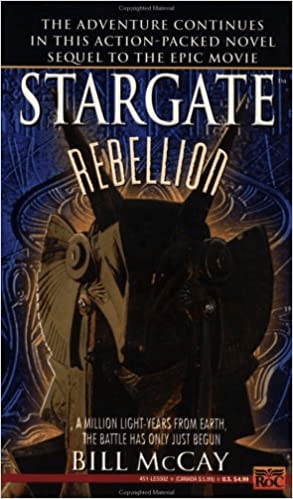
Why It Was Written
Author Bill McCay consulted the notes of the film’s directors Dean Devlin and Roland Emmerich when mapping out the story of his sequel novels to the original film. McCay would go on to write four other books to accompany Rebellion, attempting to envision where the story would have gone had there been sequels. Though there were ultimately no film sequels, the popularity of the television shows Stargate: SG-1, Stargate: Atlantis, and Stargate: Universe, act as canonical sequels to the 1994 film. McCay’s novels act as their own story, and were not consulted when creating the shows.
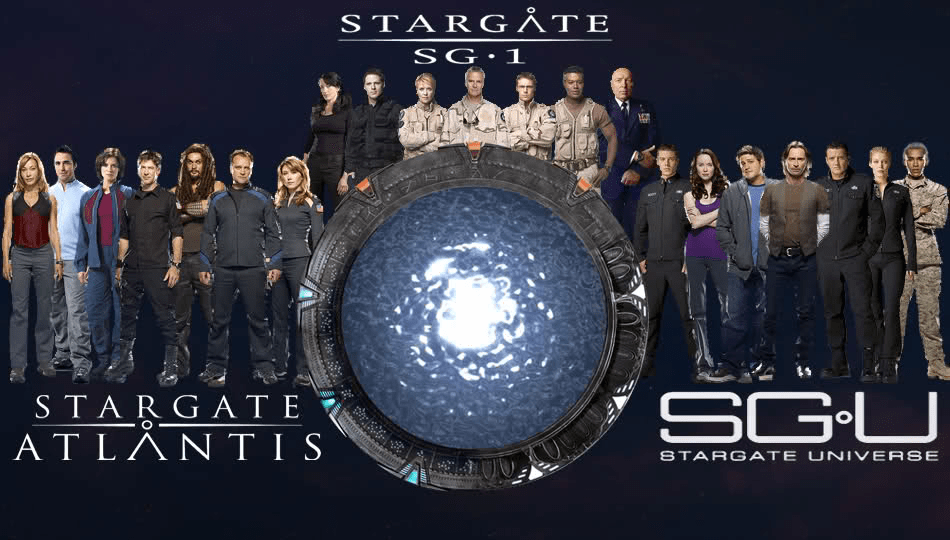
Summary
Picking up immediately after the events of the original film, the United States military is planning to return through the alien artifact known as the Stargate to the desert planet Abydos. When Egyptologist Daniel Jackson and USAF Col. Jack O’Neil first traveled to the alien world, they helped the local population of enslaved humans overthrow their tyrannical “god,” an alien called Ra. Now that the planet is free, the US is interested in obtaining new alien technologies for military use, as well as restarting the planet’s mines containing a powerful crystal substance used to power this technology. Instead of helping the native population make new lives for themselves, however, greedy corporate interests and shady military men threaten to bring their own tyranny to Abydos. Meanwhile, Ra’s empire wonders where their leader has gone, and the power vacuum of his absence leads to infighting among his lieutenants. Out of this chaos, an ancient evil is awoken to take control. Unbeknownst to those on Abydos, Ra’s successor Hathor is on her way to reclaim what once belonged to Ra.
My Thoughts
Stargate: Rebellion tells two different narratives, that of the strained relations between Abydos and Earth, and also that of the courtly drama of Ra’s empire and his successors. Both of these storylines are good on their own, and even though they only come together relatively briefly at the novel’s end, I think they tie in together well.
The former storyline about the interactions between the natives of Abydos (called Abydans) and people from Earth reminds me in some ways of the show Stargate: SG-1. While the show certainly had big, operatic moments during its season finale episodes, most of the stories involved a “planet-of-the-week” adventure, a la Star Trek. The team of heroes would visit a planet and usually confront some sort of moral quandary, such as “Can a certain number of good deeds undo one evil deed?” or “Do you have to respect a society’s culture if those cultural beliefs are actively harmful to its citizens?” At the end of the day, the team would find a way to solve the problem and establish relations with another planet.

In the novel, the US military realizes that the mineral that Ra enslaved Abydos to mine and powered all his technology would be a very valuable asset to US domination. They contract with a multinational corporation, the United Mining Consortium, to oversee the project and to enlist help from the Abydans. Unfortunately, the heads of the corporation as well as the military leaders involved see the Abydans as mere resources rather than human beings, as the novel goes out of its way to vilify almost every Earth person who isn’t a main character. But while I appreciate trying to make me hate these bigoted corporate jerks and military meatheads, sometimes I think it goes a little too far in dehumanizing the Abydans. It’s one thing for the head of UMC operations to make up the word “Abbadabbas” as the world’s first intergalactic slur or to only pay them 25 cents a day to work in the mines; it’s another for the villains (mostly the soldiers) to constantly throw around real-life slurs like “towel-heads” in my science fiction paperback. Understandable in a sci-fi story that attempts to ground itself at least somewhat in the real world, but still gets more uncomfortable the more it happens.
And the issue isn’t ever really solved. The UMC continues to treat the Abydans like dirt through the book, first denying them any rest while they work in a desert mine under two suns and then actively trying to start a coup to overthrow the “inconvenient” village elders. One of the Earth soldiers even gets a worker killed by pushing him several stories to the bottom of the mine. In the end, the conflict only ends because of an invasion by alien forces which kills nearly all of the soldiers and UMC members on-planet. While it’s fine for the corporate bad guys to be unceremoniously blown away by alien soldiers with the same carelessness they showed the Abydans, I think it might have been more interesting for them to have met their comeuppance form the Abydans themselves.
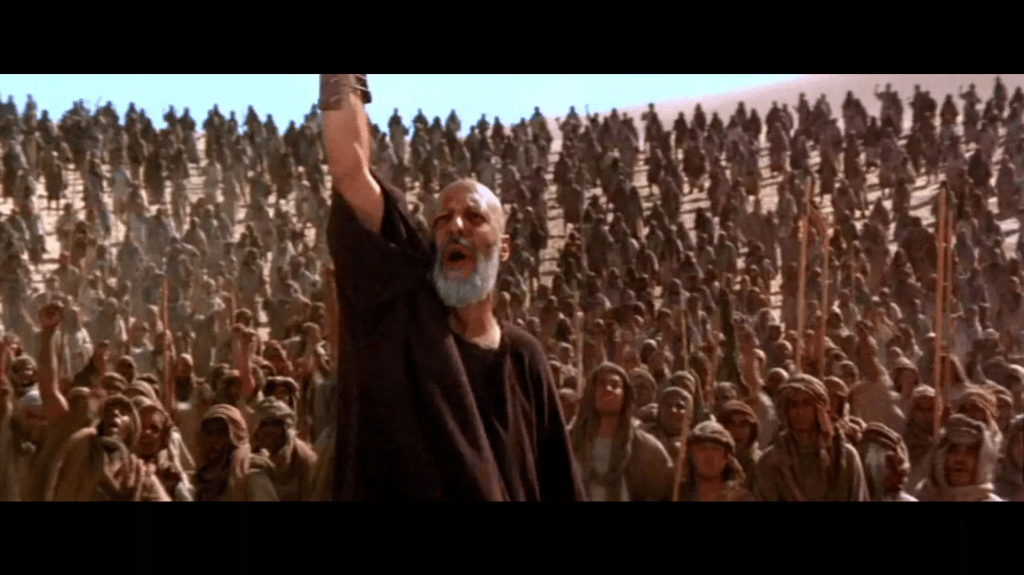
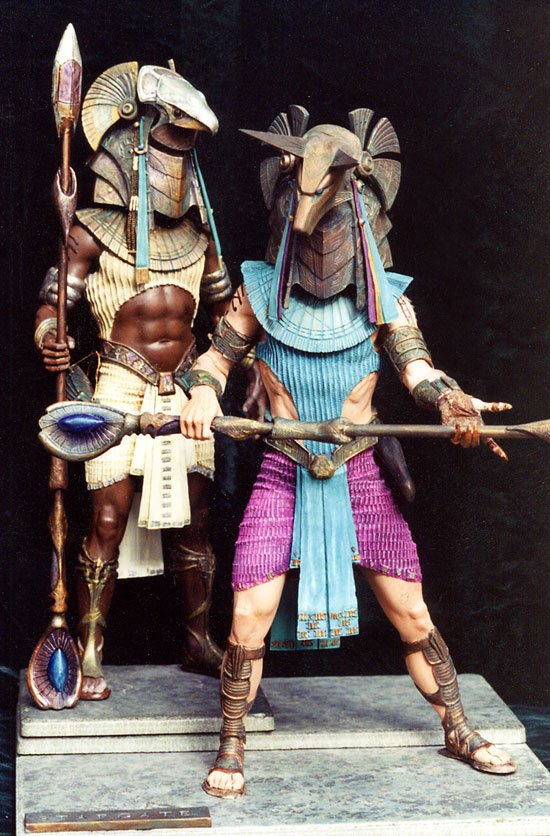
If this storyline is more in line with the Stargate TV show, the second storyline is more reminiscent of the film itself. It takes place out in space at the center of Ra’s empire, among all his futuristic technology and the members of his royal court. Echoing the conceit of the film and its Ancient Astronaut origin, these courtiers who serve Ra share names with the deities of ancient Egypt; Thoth, Sebek, Ptah, Apis, etc. This has always been the unique draw for the Stargate franchise and what drew me to it initially: the idea that the gods of the past were actually ancient misinterpretations of alien technology. In the Stargate universe, the aliens fly around in pyramid-shaped starships. Ra’s guards are called his Horus guards, and his chief lieutenant is Anubis. All high-ranking and named characters have futuristic helmets that feature their deity’s symbol (Thoth’s helmet looks like an ibis, Sebek’s a crocodile, and so on). There’s a lot of universe-building that’s already done for the creators of Stargate based on how familiar people already are with Egyptian mythology.
I also like the main villain Hathor. Some 8000 years before the novel is set, Hathor was a fearsome and ruthless general of Ra’s, famously destroying an entire planet’s population for defying him. When she was wounded, however, she was put into stasis and hidden away by Ra for the future. After Ra’s death, his scribe Thoth secretly reawakens Hathor to restore order to the squabbling nobles. This sets up the potential for a “Game of Thrones-style” story of courtly intrigue and drama. Sadly, it mostly amounts to Hathor simply killing anyone who looks at her funny. By the time she flies off to Abydos to discover Ra’s true fate, she has almost no ruling class left to obey her. And because she’s using dilapidated technology and an army of followers who formerly belonged to her enemies, it’s not shocking that she ends up losing the battle against the Abydan and Earth forces. Hathor does escape at the end of the novel and vows revenge on her new enemies. I like also appreciate that she doesn’t die at the end of the first book of this trilogy, giving her a chance to consolidate her power and return as a real threat to the heroes of Abydos and Earth. In the show Stargate: SG-1, Hathor dies like a chump by being thrown into a cryogenic vat; hopefully book Hathor won’t be taken down so easily in one of the sequels.

Between the book and the TV show, I can appreciate that they are different enough from each other to be telling their own stories. The book, for instance, keeps the continuity of the film in having Ra be the “last of a dying race” who takes over the body of an ancient Egyptian boy through a kind of possession and keeps him eternally alive with his technology. His followers, though powerful, are all humans whom Ra has chosen to serve him, including the named gods and goddesses. In the show, this was changed so that Ra was only one of the alien Goa’uld, a race of parasitic worm-creatures that physically burrow into their victims and control them as prisoners. While the book returns to Abydos because that is the only set of coordinates known to humans at the time, the show almost immediately has the team of heroes traveling to a different planet every week. In the show, Hathor is less of the warrior and bloodthirsty general, and more of a conniving puppet master. Overall, SG-1 is certainly more nuanced and sprawling than the universe presented in the book; then again, SG-1 alone went on for 10 seasons and 3 movies, so perhaps comparing the two isn’t totally fair.
Finally, some odds and ends. I thought it was really cool that Ptah, the craftsman of the gods who created Mankind in Egyptian mythology, is shown here as the engineer of Ra’s empire. And while he is still a human like the other of Ra’s “gods,” Ptah has made himself almost immortal by replacing his dying body parts with machine components and turning himself into a cyborg. The image of a grey-skinned mummy with mechanical limbs wrapped in linen wrapping shuffling around fixing a pyramid-shaped spaceship is such a cool one to me. I also like how McCay worked in the ancient Egyptian myth “The Destruction of Mankind” into Hathor’s character, making the general’s actions the model for the myth. Overall, as much as I enjoy the canonical Stargate universe, Stargate: Rebellion made me want to read the rest of the story.
One plot point I can’t get over, however, is the character Nabeh. Nabeh is a comic relief character in the original Stargate film. One of the Abydan native kids who help Jackson and O’Neil overthrow Ra, Nabeh makes funny faces and follows the Abydan gang’s leader Skaara like a puppy dog. In short, he’s a dope. But during the climactic fight with Ra’s forces, as an obviously terrified Nabeh makes a run to safety while a desperate Skaara reaches for his friend, Nabeh is engulfed by an explosion and dies. His helmet rolling out of a cloud of dust is all we see of him. It’s a very sad moment in the film that such an innocent is lost in the fight to cast off Ra’s tyranny.
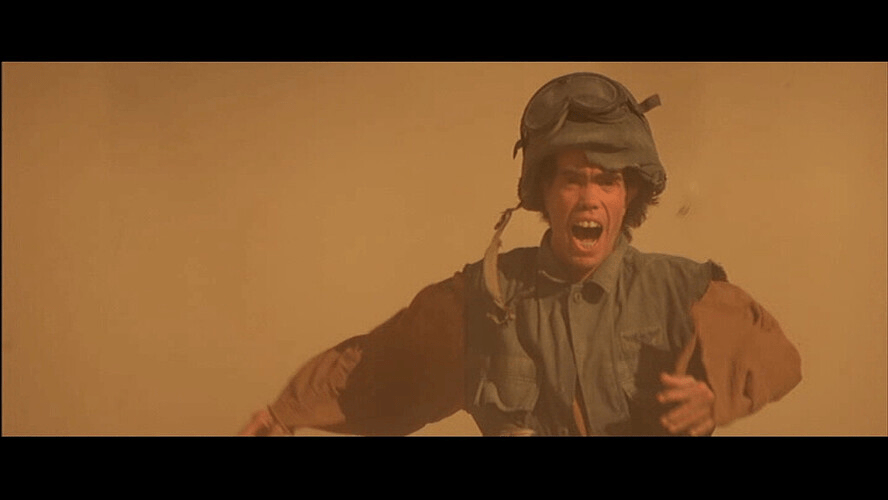
Despite this, in Chapter 3 of Rebellion, Skaara internally remarks that he needs to tell Nabeh to stop wasting what little ammunition the Abydan home guard has left, implying that Nabeh not only is alive but presumably back to being Abydos’ one-man Three Stooges show. He doesn’t appear for the rest of the book by name, seeming to indicate that this early inclusion is more of an Easter egg for fans than anything more meaningful. And I’m conflicted. Sure, I’m glad that Nabeh is alive. But he clearly and poignantly died in the film. His death had thematic meaning. I don’t know why McCay resurrected his corpse for these sequels. As far as I’m concerned, Nabeh had better not have been brought back just to die in a future novel. Poor guy has had enough.
For our next book, we’ll shift genres from science fiction to horror with a sequel to George Romero’s classic Night of the Living Dead, the aptly-named Return of the Living Dead.
 Culturally Opinionated
Pingback: Semi-Sequels Series: “Star Wars” and “Splinter of the Mind’s Eye” – Culturally Opinionated
It’s a million times better in my opinion than that hack TV show by Brad Wright and Jonathan Glassner. The Bill McCay books were approved by Dean Devlin and Roland Emmerich. And they have said they cannot stand the show. The show is nothing more than a glorified Ancient-Aliens military-themed Star-Trek knockoff. The books have some errors in them, the size of the starships is not believable when described and McCay had a horrible editor. But all in all, those books with a bit of reworking could definitely breath life back into a StarGate sequel that completely ignores the series.
LikeLike